
Ask most people what a blog is for and the answer is money. Ask 808 working content marketers and only 7% name advertising revenue as their definition of success — while 77% name traffic and visibility, and 69% name business leads and brand building.
The uses of blogs people imagine and the uses that actually pay off are different lists. That gap explains why so many blogs get abandoned. The owner picked a purpose the format is bad at, then measured it with the wrong number.
A blog is used to publish dated articles on a website you own — for personal expression, teaching, portfolio building, customer education, lead generation, customer support, original research, news reporting, and public updates. The purpose you choose decides the format, the reader’s next step, and the measure of success.
So what is a blog used for, in practice? A blog may be an entire website or one section of a larger site. TechPrevue’s guide to what a blog is covers the format itself, and what blogging is covers it as an ongoing activity. This article is about the purpose of a blog and what you can use a blog for.
- The Purpose-to-Measure Test
- What Is a Blog Used For in 2026?
- Why Do People Blog? Personal Blog Uses
- Why Do Businesses Use Blogs? Business Blog Uses
- Organizational, Educational, and Public Uses
- Blog Goals: What Bloggers Actually Say Works
- Blog Uses in India: Consent, Publishing Rules, and Reach
- When a Blog Is Not the Right Tool
- Should You Use a Blog?
- Frequently Asked Questions
The Purpose-to-Measure Test
Before reading a list of what blogs are used for, run this test on the blog you have in mind. Four columns, one row. If you cannot fill all four, you do not yet have a purpose — you have a wish.
| Purpose | Content that fits | Reader’s next step | Measure that proves it |
|---|---|---|---|
| Share knowledge | Explanations, tutorials, study notes | Read a related resource | Engaged time and return visits |
| Build a portfolio | Case studies, project breakdowns | View work or make contact | Qualified inquiries |
| Educate buyers | Comparisons, FAQs, buying guides | Visit a service or product page | Relevant onward clicks |
| Generate leads | Problem-solving resources, checklists | Subscribe, download, or inquire | Conversion rate, not page views |
| Support customers | Setup and troubleshooting articles | Resolve the problem unaided | Support tickets avoided |
| Build community | Commentary, recurring features | Subscribe or reply | Returning readers and responses |
| Report or inform | News, updates, program reports | Understand what changed | Reach among the intended audience |
| Earn revenue | Products, memberships, disclosed promotions | Purchase or join | Revenue per visitor |
One blog can serve several rows. One blog post should serve one. Choosing the measure first also tells you what to stop publishing — the fastest way to improve a blog is usually subtraction.
What Is a Blog Used For in 2026?
What are blogs used for now that AI answers sit above the results? Much the same things — but how they reach people has changed. The mechanics shifted more in the last two years than in the previous ten. Blogs now feed two systems at once: conventional search results, and AI answers built on top of them.
Google’s guidance is unusually blunt about what that does and does not require. Its guide to optimizing for generative AI search, updated in July 2026, states that there are no additional requirements to appear in AI Overviews or AI Mode. You do not need llms.txt files, special markup, “chunked” content, or any particular schema — Google Search ignores those files entirely.
What the same guide does single out is the difference between commodity and non-commodity content. It uses a memorable pair of examples: a post titled “7 Tips for First-Time Homebuyers” is common knowledge that could have come from anyone, while “Why We Waived the Inspection & Saved Money: A Look Inside the Sewer Line” carries firsthand experience that nothing else can supply.
That is the clearest statement yet of what a blog is for in 2026. It is the place to put the thing only you know. Anything that a language model could produce from general knowledge no longer earns its own URL.
Two practical consequences follow:
- Firsthand material outperforms coverage. Original research, real numbers, and lessons from work you actually did are the material AI systems reach for and cannot manufacture.
- Measure differently. Search Console now carries a generative AI performance report, so appearances inside AI features show up alongside ordinary clicks rather than vanishing from your reporting.
Rising zero-click behavior does not make blogging pointless. It changes the job from harvesting organic traffic to being the source that gets quoted — and having somewhere useful for the smaller number of people who do click.
Why Do People Blog? Personal Blog Uses
What can you use a blog for as an individual? Four things, mostly — and only the fourth involves money.
1. Share Ideas and Document Experience
A personal blog gives its author room to develop an idea past the length of a social post. Travel, creative work, career lessons, research notes, recovery from a setback — a dated archive turns scattered thinking into something you can look back through.
The comments section and categories matter less than they once did. What holds up is evergreen content you would still send someone two years later.
2. Teach a Subject or Skill
Tutorials, worked examples, and study notes help readers learn from someone a few steps ahead of them. Publishing does not make you an expert, so separate personal experience from professional advice.
That line matters most for health, finance, legal, and safety topics. Those subjects demand credentials, sourcing, and review that a hobby diary does not.
3. Build a Portfolio and Personal Brand
A blog shows how a designer, developer, marketer, teacher, or consultant actually thinks. A project breakdown proves reasoning; a claim about expertise proves nothing.
Independent blogs like Enchanting Marketing and larslofgren.com work this way — the writing itself is the credential, and the consulting follows from it. Connect the evidence to a clear biography, selected work, and one contact route.
4. Build Community or Earn Income
Recurring articles give people a reason to come back, subscribe to an email newsletter, or reply. Community still takes interaction; publishing alone does not create it.
Some personal blogs monetize through services, products, memberships, sponsored posts, display ads, or disclosed affiliate marketing. Each needs a relevant audience and a matching offer. Revenue does not arrive at a particular post count, and as the survey data below shows, ad revenue is the least common definition of blogging success among working marketers.
Why Do Businesses Use Blogs? Business Blog Uses
5. Get Found by People Who Don’t Know Your Brand Yet
A business blog answers the questions people ask before they know which company to choose. That is the top of the buyer’s journey, and it is the one place a product page cannot go.
Keyword research still helps you find those questions. It does not guarantee anything: Google’s people-first content guidance asks for content serving an existing or intended audience with original information, which is a higher bar than matching a phrase.
6. Educate Buyers and Support Sales
Posts that explain a problem, compare approaches, and answer objections do work that sales calls otherwise repeat. Sales teams can send the same article to the tenth prospect who asks the same question.
Add a relevant product page, demo, or contact option as the call to action — enough of a next step without turning the article into an ad.
7. Generate and Nurture Leads
A useful article can invite the right readers onto an email list, a resource download, or a consultation request. Match the offer to the reason they arrived; a checklist beats a demo request on an early-stage post.
Traffic is the wrong scoreboard here. Qualified inquiries, valid subscriptions, landing page visits, and assisted conversions show whether the blog is doing the job. Any form that collects personal data also carries legal obligations, covered in the India and consent section below.
8. Serve Existing Customers
Articles help customers set something up, understand an update, or fix a recurring problem. Every one of those read instead of a ticket raised is measurable support deflection.
A blog should not replace documentation or urgent support when version control or response time matters. Put the durable explanation on the blog and the exact procedure in the docs.
9. Publish Original Research and Thought Leadership
This is the strongest business use available in 2026, because it is the one thing competitors cannot copy and AI cannot generate.
Orbit Media publishes its annual blogger survey on its own blog and explicitly invites others to cite it — which is how a single research post earns links, mentions, and citations for a decade. The Content Marketing Institute runs the same play with its annual B2B research.
Almost every B2B company now says it produces thought leadership; very few produce anything with proprietary data inside it. That is the gap.
10. Show Customer Stories and Work Examples
Case studies and implementation write-ups demonstrate how you solved a real problem. They need customer permission, honest results, and enough context that a reader can tell what actually caused the outcome.
11. Announce Products, Changes, and Company News
A blog gives a launch, feature update, partnership, or policy change a permanent home with context around it. Google Search Central’s own blog works exactly this way — documentation states the rule, the blog explains why it changed.
Time-sensitive incidents still need a status page or direct message. Readers do not check a blog during an outage.
12. Support Recruitment and Employer Branding
Employee interviews, team practices, and honest role explanations help candidates understand the place before they apply. Specific beats aspirational, and the details should match the careers page.
Organizational, Educational, and Public Uses
Blogs are not only a marketing tool. These uses of blogs are the ones competitor pages usually skip, and they cover a large share of what blogs are used for in practice.
13. Teach and Publish Public Resources
Schools, universities, libraries, museums, and professional bodies publish lessons, reading guides, and research summaries. The format suits material that benefits from dates, named authors, and steady additions.
14. Report News and Events
Publishers use blogs for reporting, interviews, event coverage, and live updates. News posts need visible dates, corrections, sources, and a clear line between reporting and opinion.
15. Advocate, Raise Awareness, or Fundraise
Nonprofits and community groups explain an issue, document fieldwork, report campaign progress, and invite participation. Responsible advocacy names the publisher, supports factual claims, and explains where contributions go.
16. Provide Transparency and Program Updates
Public bodies, research groups, and funded projects publish milestones, meeting summaries, and outcome reports. The chronological archive is the point — it shows how a program changed. Formal records still belong in whatever system policy or law requires.
17. Communicate With Members or Internal Teams
A public or private blog can carry leadership notes, project retrospectives, and institutional knowledge. Confidential, regulated, or access-controlled material belongs in a secure internal system instead.
Blog Goals: What Bloggers Actually Say Works
Visibility and Leads, Not Ad Revenue
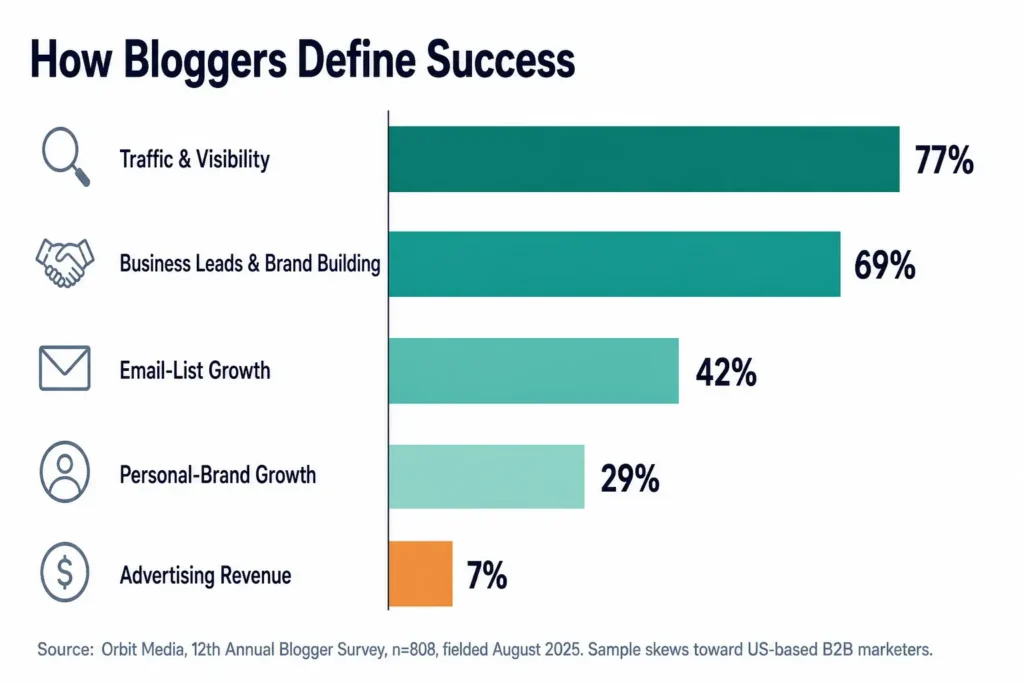
Orbit Media’s 12th Annual Blogger Survey asked 808 content marketers how they define success. Traffic and visibility led at 77%, followed by business leads and brand building at 69%, email-list growth at 42%, personal-brand growth at 29%, and advertising revenue at 7%.
The same survey found 21% reporting strong results and 60% reporting some results — so most blogs work, but few work spectacularly. It also found the top challenge is now attracting visitors from search, at 63%, with reader engagement second at 56%.
Read that as a warning about which blog goals are realistic. Visibility and relationships are what the format reliably produces. Advertising income is a minority outcome pursued by a minority of publishers.
What Correlates With Results
Three findings from that survey point the same direction. Marketers who published original research reported strong results at 25%, against the 21% benchmark. Those who always used analytics reported strong results at 32%, against 13% for those who never or rarely did. The average post ran 1,333 words and took three hours and 25 minutes.
Broader industry data agrees on where the effort should go. The Content Marketing Institute and MarketingProfs surveyed 1,015 B2B marketers for their 2026 B2B trends report: 32% planned to increase investment in owned media such as websites, blogs, and email, and 65% of effective teams credited content relevance and quality with improving their results. Their most common struggles were creating content that prompts a desired action (40%) and measuring effectiveness (33%) — the exact two problems the Purpose-to-Measure Test is designed to prevent.
On why substance beats volume, the 2025 Edelman–LinkedIn Thought Leadership Impact Report surveyed 1,934 management-level professionals in the United States. Among hidden decision-makers — the finance, legal, and procurement people who influence purchases without appearing on a sales call — 55% used thought leadership to vet vendors, 71% found it more effective than conventional marketing at showing potential value, and 64% trusted it more than marketing materials.
Treat all three as directional. These are self-reported surveys weighted toward US-based B2B professionals, the Edelman study covers videos and webinars as well as written pieces, and none of them predicts what your blog will do.
Blog Uses in India: Consent, Publishing Rules, and Reach
Anyone collecting email addresses from Indian readers now has a compliance deadline attached to that signup box, and almost no English-language guide on blog uses mentions it.
India’s Digital Personal Data Protection Rules, 2025 were notified by MeitY in November 2025, starting a phased rollout. The Data Protection Board is already operational, Consent Manager registration opens around 13 November 2026, and substantive obligations — notice, consent, security safeguards, breach reporting, and data principal rights — become enforceable on 13 May 2027. Penalties run up to ₹250 crore.
For a blog, three points matter:
- A newsletter signup is a consent event. Consent under the DPDP framework must be free, specific, informed, unconditional, and unambiguous.
- There is no legitimate-interest basis. Unlike the GDPR, the Indian law does not offer that route, so a pre-ticked box or a bundled “by subscribing you agree” line will not carry.
- The notice must stand alone. A standalone, itemized, plain-language notice separate from your terms of service, stating what you collect and why.
US-facing publishers already handle a version of this through CAN-SPAM and, for European readers, the GDPR. The practical answer is one honest signup flow that satisfies all three rather than three different forms.
Blogs also do something in India that they no longer do everywhere: reach people in languages the big platforms under-serve. A regional-language explainer often has no serious competition in search, which is the cheapest ranking opportunity most Indian publishers ignore.
When a Blog Is Not the Right Tool
A blog wastes money when the publisher cannot maintain the information, cannot name the target audience, or has nothing to offer beyond disguised advertising. It is also the wrong format when readers need formal documentation, immediate support, or a visual demonstration.
Three specific situations call for something else:
- The information changes weekly. Use documentation with version control, not dated posts that quietly rot.
- Nobody owns it. An unmaintained blog with a two-year-old newest post signals abandonment to readers and search engines alike.
- You only want the traffic. Publishing commodity posts to chase organic traffic is precisely what Google’s 2026 guidance describes as adding little unique insight.
Do not start a blog because competitors have one. Find a recurring reader question first.
Should You Use a Blog?
Use a blog when you need an owned place for material that stays useful longer than a social post or a campaign. Three questions decide it:
- Is there a recurring reader problem? If not, choose another priority.
- Can you add experience or evidence? If not, choose another format or another contributor.
- Can someone maintain it? If not, assign an owner before publishing anything.
Three yeses means starting with one useful resource and one success measure — not a content calendar. If any answer is no, improve the core website or a channel that already works.
Readers ready to build can follow TechPrevue’s guide to starting a blog, and the honest accounting of the benefits and drawbacks of blogging is worth reading before you commit.
Frequently Asked Questions
What is the main purpose of a blog?
What is a blog used for at its most basic? The main purpose of a blog is to publish useful material on a site you own, in dated articles that stay available afterward. Every other benefit — search visibility, credibility, leads, community, income — follows from readers finding that material worth their time. A blog with no defined reader problem has no purpose, only a publishing schedule.
What are the different types of blogs?
The common types of blogs are grouped by owner and intent: personal blogs for expression and documentation, professional or portfolio blogs for career credibility, business blogs for customer education and lead generation, publication blogs for news and commentary, and institutional blogs for teaching, transparency, and program updates. These types of blogs overlap, and the type matters less than the match between purpose, format, and measure.
What is the difference between a blog and a website?
The blog vs website distinction is one of scope: a website is the whole property, and a blog is a section of it organized as dated, chronological posts with an archive. Most business sites have both — static pages for services and pricing, a blog for the material that keeps arriving. A blog can also be the entire website, which is common for writers, creators, and independent publishers — many of the uses of blogs in this guide work either way.
Do blogs still work in 2026 with AI search?
Yes, with a changed job. Google confirms no special markup or files are needed to appear in AI Overviews or AI Mode, and Search Console reports those appearances. What has changed is that commodity posts covering common knowledge get little from either system, while firsthand experience, original data, and specific expertise still get surfaced and cited.
