
Technology and education have been intertwined for longer than most accounts admit, but the last decade changed the relationship. A student in a district town can now open the same lecture, dataset, and past paper as a student in Boston. That is a real change, and it is the easy half of the story — the harder half is what the evidence says actually improves learning.
Technology changed education by separating learning from a building, a timetable, and one teacher’s knowledge. Recorded lectures, open courses, and AI tutors made good material available almost anywhere. But the benefits are conditional rather than automatic: UNESCO found that learning gains disappear when technology is overused or used without a qualified teacher, and 114 education systems now ban phones in classrooms.
Technology in Education Statistics 2026: Key Numbers
Every figure below names its primary source and the date it was collected. Where a number comes from a survey, the sample size is given.
| Measure | Figure | Source |
|---|---|---|
| Education systems with national school phone bans | 114, or 58% of countries | UNESCO GEM Report, March 2026 |
| The same share three years earlier | 24% | UNESCO GEM Report, June 2023 |
| 15-year-olds distracted by devices in most or every math class | About two-thirds | OECD PISA |
| Students distracted by other pupils’ devices | Around 60% | OECD PISA |
| Score gap for frequent phone use in math class | 25 points, over half a year of learning | OECD PISA |
| Students in ban schools still using phones several times daily | 29% | OECD PISA |
| Time to refocus after a digital distraction | Up to 20 minutes | Study cited in UNESCO GEM Report |
| Education interventions with strong or moderate evidence of effectiveness | Under 2% | What Works Clearinghouse, cited in UNESCO GEM Report 2023 |
| Students left out by the pandemic shift online | At least 500 million | UNESCO GEM Report 2023 |
| Primary schools without electricity | 1 in 4 | UNESCO GEM Report 2023 |
| Higher-education students using AI in their studies | 86% | Digital Education Council, 3,839 students across 16 countries |
| Of those, using AI weekly | 54% | Digital Education Council |
| Average AI tools used per student | 2.1 | Digital Education Council |
| US teens using ChatGPT for schoolwork | 26% in 2024, up from 13% in 2023 | Pew Research Center |
| US teens using AI chatbots at all | 64% | Pew Research Center, 2025 |
| Children aged 10–12 who have used generative AI apps | 20% | JAMA Network Open, February 2026, 6,488 US youths |
| Schools and universities with established AI guidelines | 10% | UNESCO survey of 450+ institutions |
| Learning gain from AI tutors versus active-learning classes | 0.73–1.3 standard deviations | Harvard study in Scientific Reports, 2025 |
| Weekly time teachers save using AI | 5.9 hours | Gallup |
How Education Changed: Before and After
In most cases technology did not invent a new way of learning. It removed a physical or scheduling constraint from one we already had.
| What we do | Before | Now |
|---|---|---|
| Missing a lecture | Borrow a classmate’s notes | Replay the recording |
| Finding a source | Search the library catalog | Search, then check what the AI summarized |
| Asking the teacher | Wait for the next class | Post in the class channel at 11pm |
| Sitting an exam | Paper, one date, one room | Online, adaptive, often instantly marked |
| Running an experiment | A funded lab, or not at all | Virtual lab on a school laptop |
| Studying a subject your school lacks | Change schools, or give up | Open course from another university |
How Did Technology Enter the Classroom?
Each wave arrived promising transformation, and each delivered something narrower than promised. Knowing that pattern is the most useful thing to bring to the current wave.
| Era | Arrival | What it actually changed |
|---|---|---|
| 1960s–1980s | Overhead projectors, calculators, educational TV | Presentation, not pedagogy |
| 1990s | School computer labs, CD-ROM encyclopedias | Reference material left the library |
| 2000s | Broadband, interactive whiteboards, early e-learning | Lessons became multimedia |
| 2010s | Tablets, MOOCs, learning management systems, YouTube | Course material left the institution |
| 2020–2022 | Emergency remote learning at global scale | Exposed the divide rather than closing it |
| 2023–2026 | Generative AI, AI tutors, automated assessment | Still being decided |
The 2020 rupture matters most. It proved distance learning was technically possible and simultaneously showed the cost: UNESCO estimates at least 500 million students were left out of the shift online, concentrated among the poorest and most rural.
How Has Technology Changed Learning?
For students, the change is best understood as access, pace, and format. Seven shifts account for most of it.
1. Access to Learning Materials
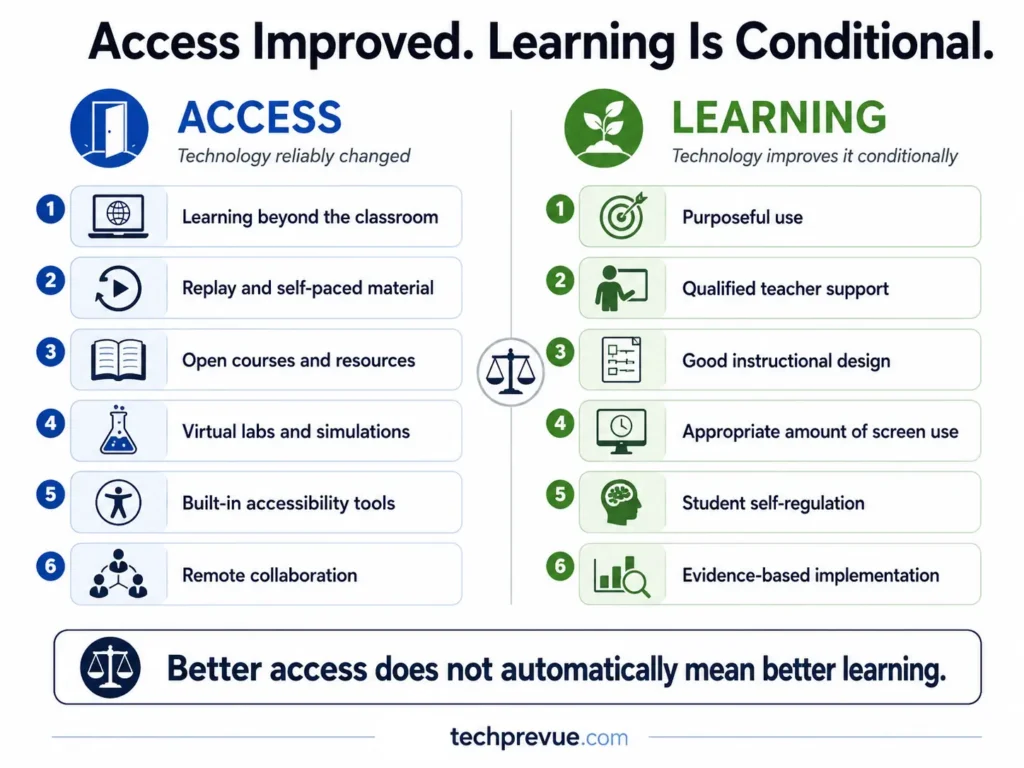
Good material stopped being rationed by postcode. Lectures from major universities, past papers, datasets, and specialist explanations are now open to anyone with a connection, which is the single largest equity gain of the last two decades.
The depth matters as much as the breadth. A student stuck on one concept can find six different explanations of it, and one of them will usually land.
- Open courses from universities including MIT, Yale, and Harvard, most auditable at no cost
- YouTube as parallel infrastructure, especially for Indian competitive exam preparation
- Open datasets and past papers that were once departmental property
- Subject communities where a specialist will answer a question a textbook does not cover
- Translated and captioned material that removes language as a barrier
Our overview of ICT in education covers the infrastructure behind this shift.
Drawback — abundance created a filtering problem. Without guidance, students spend the time they saved on searching deciding which of forty sources to trust.
2. Learning at Your Own Pace
Recorded material did something a live classroom structurally cannot. A difficult explanation can be replayed as many times as needed, at a speed the student chooses, without anyone having to ask a teacher to repeat it.
This helps two groups most: students who need longer, and students who are bored waiting. A classroom paced for the middle serves neither well.
Drawback — self-pacing assumes self-regulation. Younger students and those without a study routine at home often translate flexibility into postponement.
3. Online and Distance Learning
Degrees, certificates, and short courses now run entirely online, which opened higher education to working parents, carers, and students who cannot relocate. Cost fell alongside, since there is no campus housing or commute to fund.
The format works best where the subject is theoretical and the student is motivated. Our guides to the pros and cons of online learning, the pros and cons of online school, and the advantages of online learning set out where it does and does not hold up, and our look at online education classes covers the format choice itself.
Drawback — completion rates for open online courses remain far below classroom equivalents, and the students most likely to drop out are the ones the format was supposed to help.
4. AI Tutors and Personalized Learning
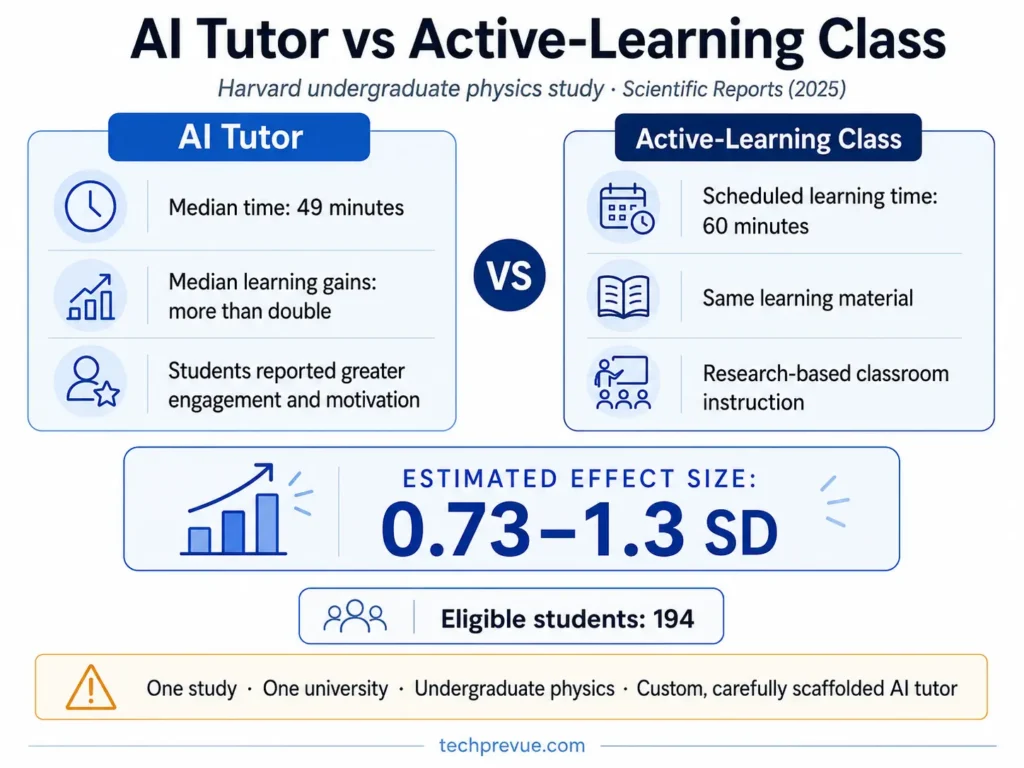
This is the newest change and, on current evidence, potentially the largest. A 2025 study by Harvard physicists, published in Scientific Reports, found students using an AI tutor learned more than twice as much in less time than students in a traditional active-learning class, with reported effect sizes between 0.73 and 1.3 standard deviations.
Effect sizes that large are rare in education research. The mechanism is unsurprising: one-to-one tutoring has always outperformed classroom instruction, and AI made it cheap for the first time.
Two cautions belong beside that finding. It was a single subject in a controlled setting, and a 2026 meta-analysis of 35 experimental studies in Humanities and Social Sciences Communications reports benefits alongside dependency and acceptance problems.
Drawback — a tutor that always answers removes the productive struggle that learning depends on. A student who never sits with confusion may pass the assessment without acquiring the skill.
5. Simulations, Virtual Labs and Immersive Learning
Simulation solved a genuine resource problem. Chemical reactions, circuit design, dissection, and engineering stress tests can now be run on a laptop, safely and repeatably, in schools that could never fund the equipment.
Virtual and augmented reality extended this to places rather than processes — historical sites, the inside of a cell, the surface of Mars.
Game-based learning developed alongside it. Well-designed educational games teach systems thinking and problem solving rather than facts, though the evidence is uneven and the label gets attached to a great deal of ordinary drill practice. Our look at whether video games are bad for you covers what the research actually supports.
Drawback — simulation teaches the model, not the mess. Real labs teach students that reagents spill, instruments drift, and results disagree, which is most of what science actually involves.
6. Accessibility and Special Educational Needs
Technology rebuilt classroom participation for students it used to exclude. Text-to-speech, speech-to-text, screen readers, adjustable fonts, live captions, and communication devices moved from specialist equipment to standard settings on ordinary hardware.
The shift from separate assistive technology to built-in features matters socially as well as practically. A student using the same device as everyone else is not visibly marked out.
Drawback — these tools depend on newer hardware, updated software, and trained staff. Schools with the least funding have the most students who need them.
7. Collaboration and Peer Learning
Group work stopped requiring the same room. Shared documents, class channels, and version history let students draft together, see each other’s reasoning, and pick up work asynchronously.
Peer explanation is one of the better-evidenced learning mechanisms, and messaging made it continuous rather than confined to class time. For the wider picture, see how technology improved communication.
Drawback — visible collaboration makes free-riding easier to hide and harder to confront, and group chats blur the line between helping and supplying the answer.
How Has Modern Technology Changed Teaching?
Teaching changed less visibly than learning, but in ways that shape what students actually receive. Modern technology reshaped preparation, marking, and contact with families more than it reshaped what happens in the lesson itself, and five shifts account for most of that.
8. Lesson Planning and Preparation
Preparation moved from building from scratch to curating and adapting. Shared repositories, subject communities, and open resources mean a teacher can start from something workable rather than a blank page.
AI accelerated this sharply. Gallup found teachers using AI weekly save an average of 5.9 hours, roughly six weeks of reclaimed time across a school year.
Drawback — time saved is not automatically time returned. Where workloads expand to fill it, the gain reaches the school rather than the teacher.
9. Assessment and Feedback
Marking moved from a weekend task to a partly automated one. Quizzes mark themselves, plagiarism checks run in seconds, and feedback reaches students while the work is fresh rather than a fortnight later.
Speed changes what feedback can do. A comment that arrives the same day can still alter the next attempt.
Drawback — what is easy to mark automatically is not what is most worth assessing. Multiple choice scales; an argument does not.
10. Classroom Tools and Interactive Displays
Interactive displays replaced chalkboards in most funded classrooms, bringing annotation, saved lessons, live polling, and instant retrieval of any resource mid-lesson.
The genuine gain is smaller than the marketing suggested. A saved, shareable lesson helps absent students; the touchscreen itself does not teach.
Drawback — hardware budgets consistently outrun training budgets. An interactive display used as a projector is an expensive projector.
11. Communication with Students and Parents
Contact stopped being confined to school hours and parents’ evenings. Email, messaging, and school portals let teachers flag a problem the week it appears rather than the term it appears.
Parents gained visibility into attendance, marks, and homework that previously arrived twice a year on paper.
Drawback — continuous access became continuous availability. Teachers now field messages in the evening, and few schools have set the boundaries that would prevent it.
12. Learning Analytics
Systems now record who submitted what, when, and how long they spent. Used carefully, that identifies a struggling student in week three rather than at the exam.
Drawback — analytics measure engagement, not understanding, and a student who games the metrics looks identical to one who is learning.
How Has AI Changed Education in 2026?
AI moved from novelty to default faster than any previous education technology. The question is no longer whether students use it but what that use is doing to learning.
13. How Students Actually Use AI
Adoption is close to universal in higher education. The Digital Education Council’s survey of 3,839 students across 16 countries found 86% using AI in their studies, 54% weekly, and students running an average of 2.1 different tools rather than one.
School-age use is lower but climbing quickly. Pew Research Center found 26% of US teens used ChatGPT for schoolwork in 2024, double the 13% who did so in 2023, and a February 2026 study in JAMA Network Open tracking 6,488 US youths found 20% of children aged 10 to 12 had used generative AI apps.
Most of that use is not cheating. Students report using AI to explain concepts, outline, brainstorm, and check reasoning far more often than to produce work they submit unchanged.
Drawback — institutions are far behind their students. A UNESCO survey of more than 450 schools and universities found only 10% had established guidelines for AI use.
14. What the Research Shows About AI Tutoring
The strongest result so far is the Harvard physics trial, and it is genuinely strong. Students working with an AI tutor learned more than twice as much in less time than a control group in an active-learning classroom, a result published in a peer-reviewed journal rather than a vendor white paper.
The honest framing is that this is one subject, one institution, and one study design. The 2026 meta-analysis of 35 experimental studies finds real gains in engagement and motivation alongside consistent warnings about dependency.
Drawback — the wider evidence base is thin. UNESCO cites the What Works Clearinghouse finding that under 2% of education interventions assessed had strong or moderate evidence of effectiveness, and AI tools are entering classrooms far faster than that evidence accumulates.
15. Academic Integrity and Assessment
Assessment built on unsupervised written work stopped being reliable. When a competent essay can be produced in seconds, the essay no longer evidences the thinking it was designed to measure.
Schools and universities are responding by moving assessment rather than policing it:
- Supervised writing sessions where drafts are produced in the room
- Oral defenses in which a student explains their own reasoning
- Process evidence such as version history rather than a finished file
- Open-AI assessments that require students to document and critique what the tool produced
Each tests whether the student can hold the argument themselves, which is what the essay was always meant to measure.
Drawback — detection tools are unreliable in both directions, and a false accusation costs a student more than an undetected one costs the institution.
What Are the Disadvantages of Technology in Education?
The costs are better documented than the benefits, which is itself a finding. Five are established well enough to act on.
1. Distraction and the Phone Ban Wave
The distraction evidence is now substantial, and it is the main reason technology in schools became a policy question rather than a procurement one. OECD PISA data shows about two-thirds of 15-year-olds report being distracted by digital devices in most or every math class, around 60% report being distracted by other students’ devices, and frequent phone use during math associates with scores 25 points lower — more than half a year of learning.
Policy moved fast in response. UNESCO’s GEM Report counted 114 education systems with national school phone bans by March 2026, 58% of countries, up from 24% in June 2023, with France extending its ban to high schools from the 2026–27 school year.
Bans are not a complete solution. OECD data shows 29% of students in schools with bans still use phones several times a day, and researchers have raised the possibility that restricted daytime use displaces into the night. The OECD’s own analysis argues that targeted device use can still support learning, which is a narrower claim than either side of the ban debate usually makes.
Drawback — removing the device does not build the judgment. School remains one of the few places where students can learn to manage attention deliberately, and a ban alone teaches nothing about how.
2. The Evidence Problem
This is the finding that should reframe the whole topic. Most claims about educational technology rest on weak evidence, vendor research, or studies of the technology by the people selling it.
UNESCO’s position is that some technology supports some learning in some contexts, and that benefits disappear when it is overused or deployed without a qualified teacher. Distributing devices without involving teachers in the pedagogy does not improve learning.
Drawback — procurement moves faster than evaluation. Schools commit budgets on the strength of pilots that would not survive peer review.
3. The Digital Divide
Access is the precondition everything else assumes. Debates about technology in schools tend to be written from countries where power and broadband are a given, yet UNESCO reports that one in four primary schools worldwide lack electricity, which makes the connectivity question premature in those settings.
The divide is not only between countries. Within them, home broadband, a quiet place to work, and a device that is not shared decide who benefits from any of the changes above. Our guide to the importance of the internet puts numbers to that dependence.
Drawback — each new layer widens the gap it was meant to close. AI tutoring will help the connected student more than the unconnected one, exactly as recorded lectures did.
4. Screen Time and Wellbeing
Displacement is the clearer harm. Hours spent on devices are hours not spent sleeping, moving, or in unstructured conversation, and sleep disruption has the most consistent supporting evidence of any mechanism studied.
Our guides to the negative effects of smartphones and taking a social media detox cover what the research supports and where it remains contested.
Drawback — schools issuing devices are increasing screen exposure while asking families to reduce it, and few have reconciled the two positions.
5. Teacher Workload and Training Gaps
Every new system arrives with an implicit demand on teacher time: learning it, maintaining it, and troubleshooting it during lessons. Training budgets rarely match hardware budgets.
Drawback — technology introduced without training tends to be used at its shallowest setting, which produces the disappointing results that then get blamed on the technology.
Has Technology Actually Improved Education?
Yes in access, unevenly in outcomes, and the honest answer holds both. The gains are real where technology supports a teacher, and thin where it substitutes for one.
| What improved | What it cost |
|---|---|
| Good material reaches almost anywhere | Filtering became the student’s problem |
| Students set their own pace | Self-pacing assumes self-regulation |
| One-to-one tutoring became affordable | Productive struggle is easy to skip |
| Labs and simulations without funding | Simulation teaches the model, not the mess |
| Accessibility built into ordinary devices | Newest hardware needed by poorest schools |
| Feedback arrives while work is fresh | What marks easily is not what matters most |
| Teachers save hours weekly | Attention in class became harder to hold |
The pattern across every row is the same. Technology reliably improved access to education and much less reliably improved learning, and confusing the two is how expensive programs get approved.
For the wider view, see how technology has changed our lives across work, health, and society.
Frequently Asked Questions
How has technology changed education?
Technology separated learning from a fixed building, timetable, and teacher. Recorded lectures, open courses, virtual labs, and AI tutors made material available almost anywhere, while assessment, feedback, and parent communication moved online. Access improved more reliably than learning outcomes did.
What are the disadvantages of technology in education?
Five are well documented: classroom distraction, with OECD data linking frequent phone use to scores 25 points lower in math; a thin evidence base for most edtech claims; the digital divide; sleep and wellbeing displacement; and teacher workload from systems introduced without training.
How is AI changing education in 2026?
Adoption is near-universal in higher education, with 86% of students across 16 countries using AI in their studies according to the Digital Education Council. A 2025 Harvard trial found AI tutors doubled learning compared with active-learning classrooms, though only 10% of institutions have AI guidelines in place.
Do phone bans in schools work?
Partly. UNESCO counts 114 education systems with national bans by March 2026, and studies in Belgium, Spain, and the UK found improved outcomes, especially for lower-performing students. But OECD data shows 29% of students in ban schools still use phones several times daily.
How has modern technology changed teaching?
Modern technology changed preparation, assessment, and communication more than instruction itself. Teachers now curate and adapt shared resources rather than building from scratch, quizzes mark themselves, feedback reaches students the same day, and Gallup found teachers using AI weekly save 5.9 hours.
What is the role of technology in schools today?
Technology in schools now serves three roles: delivering material, handling assessment and admin, and connecting teachers with families. UNESCO’s position is that it should be used only where it clearly supports learning outcomes, which is why 114 education systems restrict phones while still funding classroom devices.
Is online learning as effective as classroom learning?
It depends on the subject and the student. Online works well for theoretical material and motivated, self-regulating learners, and poorly for practical work, supervised assessment, and students who need structure. Completion rates for open online courses remain far below classroom equivalents.
Does technology improve learning outcomes?
Only conditionally. UNESCO’s position is that some technology supports some learning in some contexts, and that gains disappear when it is overused or used without a qualified teacher. Under 2% of assessed education interventions show strong or moderate evidence of effectiveness.
The Bottom Line
How technology has changed education is now a question with actual data behind it, and the data is less flattering than two decades of marketing suggested. Access improved enormously. Learning improved where technology supported a skilled teacher and barely at all where it replaced one.
The most useful thing to carry into the AI wave is the pattern from every wave before it. Technology and education have met like this five times already, and each time the technology arrived promising transformation, delivered something narrower, and worked best in the hands of teachers who were trained and trusted to use it well.
AI tutoring may prove the exception — the early trial results are stronger than anything educational technology has produced before. It is still one study, in one subject, and the institutions deploying it are, by UNESCO’s count, nine times more likely to lack a policy for it than to have one.
