
Quick answer: The clearest signs you need a break from social media are feeling worse after a session than before it, opening and reopening apps without noticing, losing sleep you can account for, and having tried to cut back unsuccessfully more than once.
Other frequently listed signs matter far less than they are made to sound. Checking your phone on waking, following people you never speak to, and scrolling while someone talks to you are near-universal among heavy users.
Most articles present all of these as equally alarming. They are not, and treating them that way is why sign lists tend to leave people either anxious or dismissive. The fifteen signs below are each labeled by how much concern they actually warrant.
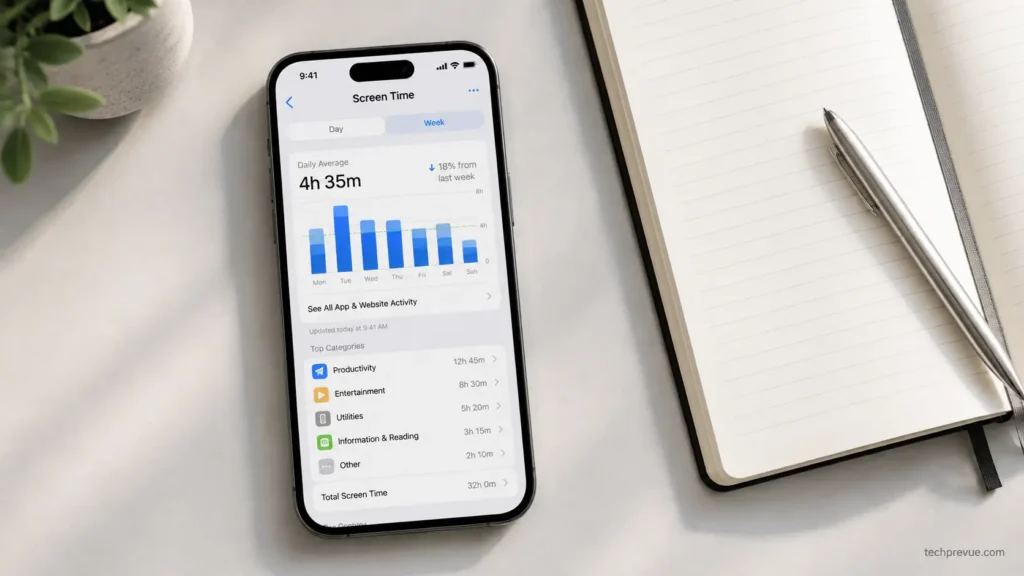
The 30-second check
If you read nothing else, answer these three honestly:
- Do you feel worse after a session than you did before it?
- Have you tried to cut back and failed more than once?
- Is being away from your phone boring, or genuinely uncomfortable?
One yes is worth noticing. Two or three suggests a break is worth trying. If the answer to the third is firmly “uncomfortable,” that is the one to raise with someone rather than handle alone.
How to read this list
Each sign below carries one of three labels. They describe how much concern the sign warrants, not what is wrong with you.
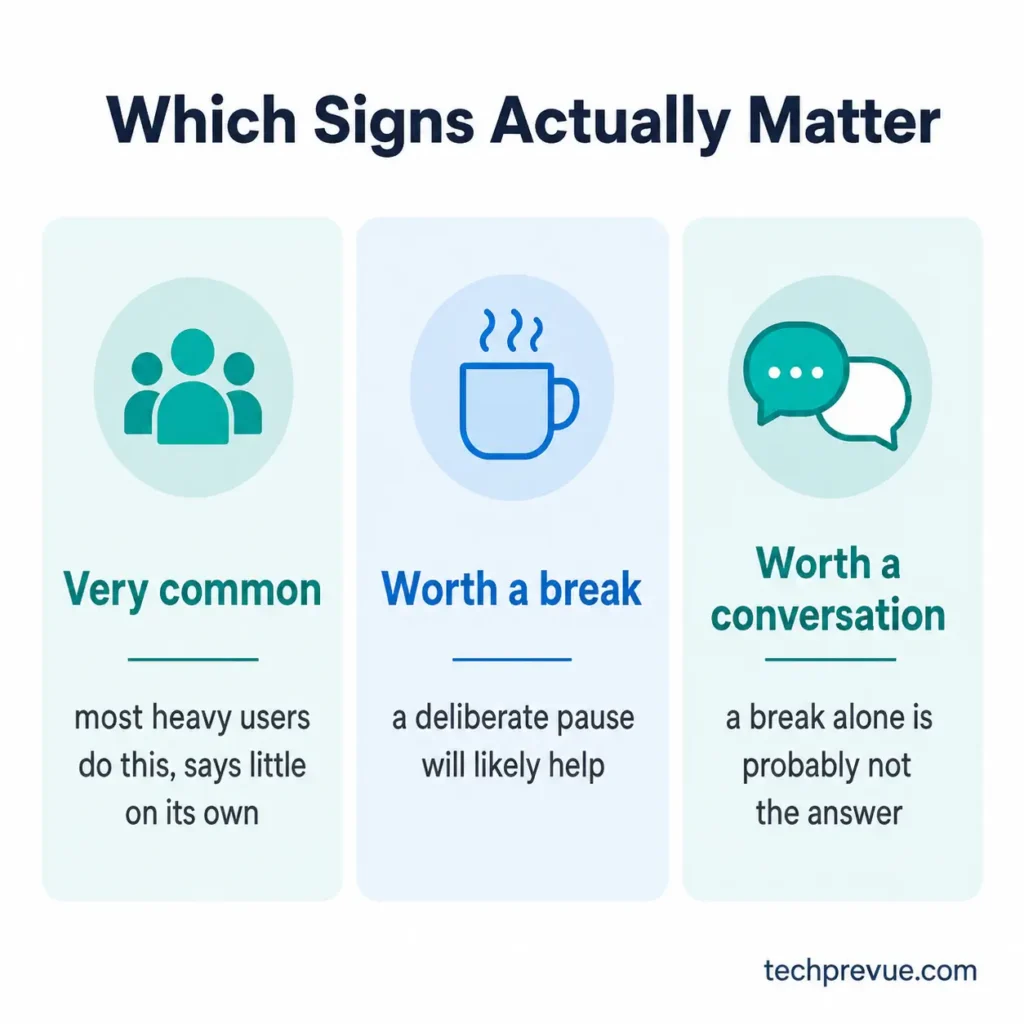
- Very common — most heavy users do this. On its own it says little.
- Worth a break — a deliberate pause will likely help.
- Worth a conversation — a break alone is probably not the answer.
This is reflection, not screening. There is no score, and no combination of signs diagnoses anything. If several have been true for months, that matters more than how many are true today.
One more thing worth saying before the list. Taking a break from social media is a low-cost experiment, not a verdict on your character — you can run it, learn something, and go back.
Signals you can measure, not just feel
Start here, because feelings are the least reliable evidence you have about your own habits. Anyone underestimating their usage will keep underestimating it. Device data will not flatter you.
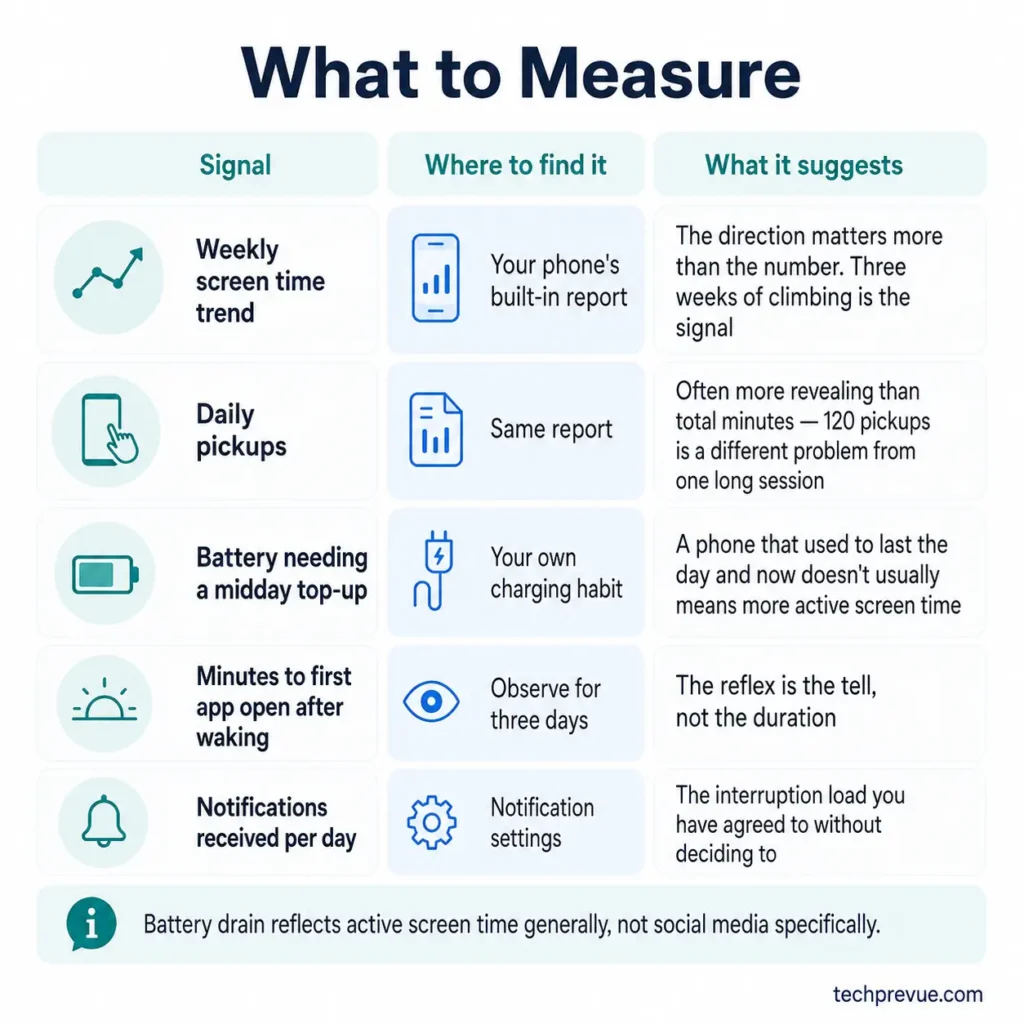
| Signal | Where to find it | What it suggests |
|---|---|---|
| Weekly screen time trend | Your phone’s built-in report | The direction matters more than the number. Three weeks of climbing is the signal |
| Daily pickups | Same report | Often more revealing than total minutes — 120 pickups is a different problem from one long session |
| Battery needing a midday top-up | Your own charging habit | A phone that used to last the day and now doesn’t usually means more active screen time |
| Minutes to first app open after waking | Observe for three days | The reflex is the tell, not the duration |
| Notifications received per day | Notification settings | The interruption load you have agreed to without deciding to |
A note on the battery signal, because it gets overstated online. Faster drain reflects active screen time generally, not social media specifically — video calls, navigation, and gaming will do the same thing.
Aging batteries also lose capacity on their own. Treat it as a rough prompt to check your screen time report, not as evidence by itself.
The advantage of all five is that they are external. You do not have to be honest with yourself for a screen time report to be accurate.
Time and attention signs
1. You check within minutes of waking
Very common. The overwhelming majority of heavy users do this, and on its own it indicates habit rather than harm. It becomes meaningful when the check reliably sets the tone for your morning — when what you see in the first five minutes determines your mood for the next two hours.
2. You open, close, and reopen without noticing
Worth a break. This is the clearest evidence that the behavior has stopped being a decision. You closed the app because there was nothing new, and forty seconds later you opened it again looking for the same nothing.
3. “Just five minutes” reliably becomes forty
Worth a break. Occasional time loss is normal on platforms designed to produce it. The signal is reliability — if the overrun happens most times, the intention was never really in control.
4. You have stopped finishing things
Worth a break. Books left half-read, articles abandoned midway, films paused and never resumed. Fragmented attention recovers, but it is worth noticing when the pattern shifts across everything rather than just one thing.
Emotional signs
5. You feel worse after a session than before it
Worth a break. If you only ask yourself one question from this page, ask this one. Entertainment that reliably leaves you flatter than it found you has stopped being entertainment.
6. Specific accounts reliably affect your mood
Worth a break. Notice that this is targeted rather than general. If three or four particular accounts produce the same low feeling every time, the problem may be your feed rather than the platform.
7. You check the response to your own posts repeatedly
Very common. Almost everyone who posts does this, and platforms are built to encourage it. It shifts when the number itself changes how you feel about the thing you posted, or about yourself.
8. You use it to avoid a feeling rather than to find something
Worth a conversation. There is a real difference between opening an app out of curiosity and opening it because something else in the room is uncomfortable. The second pattern tends to persist after a break unless the underlying thing is addressed.
Relationship signs
9. You scroll while someone is talking to you
Very common. Widespread, and worth changing, but it reflects a social norm as much as an individual habit. It matters more when the other person has started commenting on it.
10. You know everything about people you have not spoken to in years
Very common. Passive following is what these platforms are for. Worth examining when it substitutes for contact you would otherwise want — when you know about a friend’s new job from a post rather than from them.
11. Someone has mentioned it to you more than once
Worth a break. Outside observation is more reliable than self-assessment, particularly here. If a partner, parent, or friend has raised it twice, that is data you do not have access to yourself.
Physical and sleep signs
12. It is costing you sleep you can name
Worth a break. Not “I’m tired” but “I was awake until 1:30 and I know where the time went.” Sleep is also the outcome most likely to improve quickly, which makes it a useful thing to test.
13. You feel restless when your phone is in another room
Worth a conversation. Mild awareness is normal. Genuine restlessness — checking where it is, going to get it, difficulty settling without it — is a different order of thing and tends not to resolve with a weekend off.
Signs it is more than a habit
These two are different from everything above. They are less about how much you use social media and more about what happens when you try to stop.
14. You have tried to cut back and failed repeatedly
Worth a conversation. One abandoned attempt means the plan was wrong. A pattern of intending to stop, stopping briefly, and returning to the same level suggests something that willpower and a better plan have not been able to reach.
15. Stepping away produces distress rather than boredom
Worth a conversation. Boredom during a break is expected and fades. Anxiety, agitation, or a low mood that arrives specifically when you are away from the platform is worth raising with a professional rather than pushing through alone.
Moments worth taking a break even with no signs at all
Some of the best times to step away have nothing to do with your habits. They have to do with what is happening in your life while the feed keeps running.
- After a breakup, or any personal event other people know about. Your feed becomes a place where the event follows you, in algorithmic reminders and in other people’s reactions.
- During a job search, or after a layoff. Career milestones from your network land differently when yours is uncertain.
- Exam season and results season. Comparison at exactly the moment concentration matters most, and score-sharing culture makes this significantly worse in India than in most markets.
- After a post gets unexpected attention. Whether the response is positive or hostile, checking becomes compulsive in a way it never was before.
- During an election or a major news cycle. Feeds become dense with conflict, and the volume has nothing to do with what you can act on.
- After a bereavement. Memorialized accounts and birthday reminders surface without warning, and no platform handles this gracefully.
- In the first months of a new baby. Broken sleep plus a phone in hand at 3am is a specific and well-known trap.
None of these mean anything is wrong with you. They mean the timing is bad, and a short pause costs almost nothing.
The common thread is that each situation changes what the feed does to you without changing how much you use it. Your habits stay identical; the material they deliver turns hostile.
This is the case for taking a break from social media that sign lists systematically miss. You can score clean on every question above and still be in a week where stepping away is the obvious move.
Habit or problem? How to tell the difference
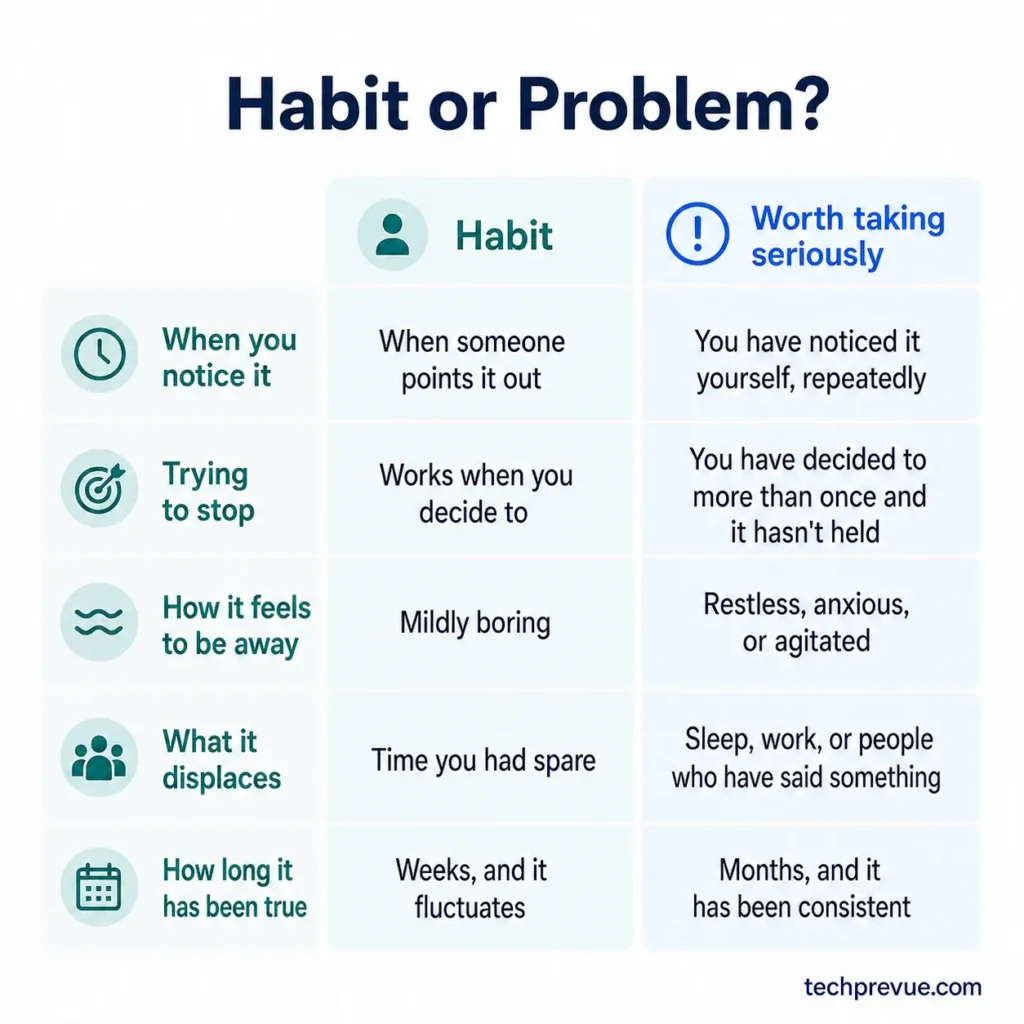
Most sign lists blur these together. The distinction is straightforward once you look for it.
| Habit | Worth taking seriously | |
|---|---|---|
| When you notice it | When someone points it out | You have noticed it yourself, repeatedly |
| Trying to stop | Works when you decide to | You have decided to more than once and it hasn’t held |
| How it feels to be away | Mildly boring | Restless, anxious, or agitated |
| What it displaces | Time you had spare | Sleep, work, or people who have said something |
| How long it has been true | Weeks, and it fluctuates | Months, and it has been consistent |
The right-hand column does not mean something is seriously wrong. It means a weekend off is unlikely to be enough on its own, and it is worth talking to someone.
How to spot it in someone else
The most common version of this search is not about the person searching. It is a parent, a partner, or an adult child trying to work out whether to say something.
What to look for: withdrawal from things they used to enjoy; irritability that spikes specifically when the phone is taken away or unavailable; sleep that has visibly changed; and secrecy around use — angling the screen, closing apps when you enter the room.
What not to read too much into: volume alone. Plenty of people use social media heavily with no ill effect, and teenagers using it constantly is the norm rather than the exception.
How to raise it. Lead with the specific thing you noticed rather than the phone itself — “you’ve seemed flat this month” lands, “you’re always on that thing” does not. Ask rather than tell, and pick a moment when neither of you is already annoyed.
If it’s a teenager, running it as a household change rather than a rule imposed on one person makes an enormous difference to whether it survives the first week.
Be honest about your own use before raising theirs. A parent scrolling through dinner while asking a teenager to put their phone away is making an argument that will not land, and the teenager already knows it.
One caution worth keeping in mind. Withdrawal, irritability and sleep changes are not specific to social media — they accompany plenty of other things a young person might be dealing with. Noticing them is a reason to ask what is going on, not to conclude you already know.
Set up your own early warning
Rather than relying on noticing, let the data reach you.
Turn the weekly report into a notification
Both iPhone and Android generate a weekly usage summary, and both can push it to you rather than waiting to be opened. Turn that on and read it once a week.
That is the entire setup. It removes the need to be objective about yourself, which is the part nobody is good at.
What to look at when it arrives
Two things. The trend across several weeks rather than any single week, and the pickup count.
Pickups matter because they reveal compulsive checking that total minutes can hide. Ninety minutes in one sitting and ninety minutes across 140 pickups are different problems.
If the report alone doesn’t move you
Pick one number — pickups per day is usually the most uncomfortable — and write it down each Sunday for a month.
Four data points is enough to show a direction. A direction is far harder to dismiss than a single week you can write off as unusual.
Where this stops
This is detection, not intervention. Setting limits and blocking apps is a different exercise, and it belongs to the guides linked at the end.
What the research actually says
This is where most articles on this topic oversell, so here is the honest position. Two large meta-analyses published in 2025 reached different conclusions, and both are worth knowing about.
The evidence that stepping back helps
Burnell and colleagues, writing in SSM–Mental Health, pooled 32 randomized controlled trials covering 5,544 people and 91 effect sizes.
They found that restricting social media use significantly improved subjective well-being — but the effect was small, at ḡ = 0.17 (95% CI 0.08–0.27). They found no evidence that the length or type of intervention changed the outcome.
The evidence that it doesn’t
Lemahieu and colleagues, writing in Scientific Reports, looked only at complete abstinence, and only at mood and life satisfaction.
Across 10 studies and 4,674 participants they found no significant effect on positive affect, negative affect, or life satisfaction. Duration made no difference there either — four weeks performed no better than one.
How to read the two together
Any average benefit is small and inconsistent across studies and outcomes. Nobody has shown that one approach reliably beats another.
It would be wrong to read the second study as proof that breaks don’t work, or the first as proof that they do. Both are large, both are careful, and they measured different things.
What this means for you
The evidence supports something narrower and more useful. People who start out struggling most tend to gain most, and a short break is cheap enough to test on yourself.
It is also worth being clear about what an average hides. A small mean effect across thousands of people is entirely compatible with some improving a great deal and others not at all.
That is why taking a break from social media is best treated as a personal experiment rather than a prescription. The question is not whether it works in general, but whether it does anything for you.
What to do next
Match the action to what you found. Taking a break from social media is not a single thing — the right size of it depends entirely on which labels showed up above.
- Mostly “very common” labels — you likely don’t need anything structured. A single phone-free evening is enough to confirm that.
- Several “worth a break” labels — a social media break is the right size of intervention. A weekend is enough to learn something.
- You want to measure the change — a structured social media detox with a recorded baseline will tell you more than an unmeasured break.
- Any “worth a conversation” labels, sustained over months — speak to a doctor or a mental health professional. That is not an escalation, it’s just the appropriate tool.
For readers in India
Two things make this different here.
Usage is heavier and starting younger. Indian daily social media use runs above the global average, and cheap data means the phone is often the only internet device in a household rather than one of several.
The regulatory position differs from Australia’s. India has not introduced a minimum age for social media accounts. The Digital Personal Data Protection (DPDP) Rules, notified in November 2025 and phasing in over roughly 18 months, instead require verifiable parental consent before platforms process the data of anyone under 18.
The DPDP framework also restricts tracking, behavioral monitoring and targeted advertising directed at children, subject to statutory exemptions. It regulates how platforms handle children’s data rather than barring under-18s from holding accounts.
Practically, that means enforcement will not arrive from outside. Exam and results season is also a distinctly Indian pressure point — score-sharing on family groups and public boards makes comparison unavoidable at precisely the wrong time.
Frequently asked questions
What are the signs you need a break from social media?
The clearest are: feeling worse after a session than before it, opening and reopening apps without noticing, losing sleep you can account for, and having tried to cut back unsuccessfully more than once. Checking your phone on waking and following people you rarely speak to are extremely common and mean little on their own.
How do I know if I’m addicted or just a heavy user?
The distinction is not volume, it’s what happens when you try to stop. Heavy use that you can pause when you decide to is a habit. Repeated failed attempts, or genuine distress when you’re away from the platform, is worth discussing with a professional.
How much social media use is too much?
There is no validated threshold, and any number you see quoted is arbitrary. What matters more is whether your use is displacing sleep, work, or people, and whether you feel able to stop when you want to.
Is checking my phone first thing in the morning a bad sign?
On its own, no — it’s near-universal among regular users. It becomes worth attention when what you see in those first minutes reliably determines your mood for hours afterwards.
Does taking a break from social media actually help?
The evidence is mixed. One 2025 meta-analysis of 32 randomized trials found a small but significant improvement in well-being; another, covering only complete abstinence, found no significant effect on mood or life satisfaction. Benefits appear largest for people struggling most beforehand, and a short break costs little to test.
How long should the break be?
For working out whether you need one, a weekend is enough. Research has not shown that longer breaks work better than shorter ones, so start small.
Can my phone tell me if I need a break?
Partly. Weekly screen time reports, daily pickup counts, and how quickly you open an app after waking are objective signals that don’t depend on your own judgment. Faster battery drain is a rough prompt to check that report, not evidence by itself.
How do I tell my teenager they need a break?
Lead with a specific change you’ve noticed rather than with the phone, ask rather than tell, and make it a household change instead of a rule for one person. Rules applied to everyone survive far longer than rules imposed downward.
When is the best time to take a break?
When the signs point to it, or when your circumstances do. Taking a break from social media is often most useful during a job search, exam season, after a breakup, or during a heavy news cycle — moments when the feed turns hostile even though your habits have not changed.
Is a break the same as a detox?
No. A break is short, light, and repeatable. A detox is longer and structured, usually with a recorded baseline so you can measure what changed.
What if I take a break and nothing changes?
That’s a legitimate result, and the research suggests it happens for plenty of people. It’s useful information: it means social media probably isn’t the main driver of what you were hoping to fix, which is worth knowing before you spend more effort on it.
When to talk to someone
Nothing on this page diagnoses anything, and no combination of signs adds up to a condition.
If low mood, anxiety, or sleep problems have lasted more than a few weeks, or if being away from your phone produces real distress rather than mild boredom, that is worth raising with a doctor or a mental health professional.
India: Tele-MANAS is free and available 24/7 on 14416 or 1-800-891-4416, in English and 20 regional languages.
United States: the 988 Suicide and Crisis Lifeline is available 24/7 by calling or texting 988.
This article is for general information and is not medical advice.
Sources: Burnell, K., Meter, D., Andrade, F., Slocum, A., & George, M. (2025). The effects of social media restriction: meta-analytic evidence from randomized controlled trials. SSM–Mental Health, 7, 100459. Lemahieu, L., Vander Zwalmen, Y., Mennes, M., Koster, E. H. W., Vanden Abeele, M. M. P., & Poels, K. (2025). The effects of social media abstinence on affective well-being and life satisfaction: a systematic review and meta-analysis. Scientific Reports, 15, 7581. Ministry of Electronics and Information Technology, Digital Personal Data Protection Rules 2025. Ministry of Health and Family Welfare, Tele-MANAS.
