
For the first time in the internet’s history, most of the traffic on it is not human.
In June 2026, Cloudflare published network data showing that automated requests generate 57.5% of all HTML web traffic, against 42.5% from people. That single number says more about the importance of the Internet than any catalogue of advantages could. A network carrying more machine traffic than human traffic has stopped being a tool people use and become infrastructure that runs whether anyone is watching or not.
This guide covers the real benefits of the internet in 2026, who actually receives them, who still does not, and what it costs when access disappears. Every figure here is sourced and dated.
Quick Answer: Why Is the Internet Important?
What is the importance of the internet, in one paragraph?
The internet is important because roughly 6 billion people — about 74% of humanity — now depend on it for education, work, healthcare, money, and government services, according to the ITU. It has become the delivery layer for things that used to require physical presence. Its importance is measurable in what breaks when access is removed: shutdowns cost economies hundreds of millions of dollars and cut people off from banking, schooling, and emergency services.
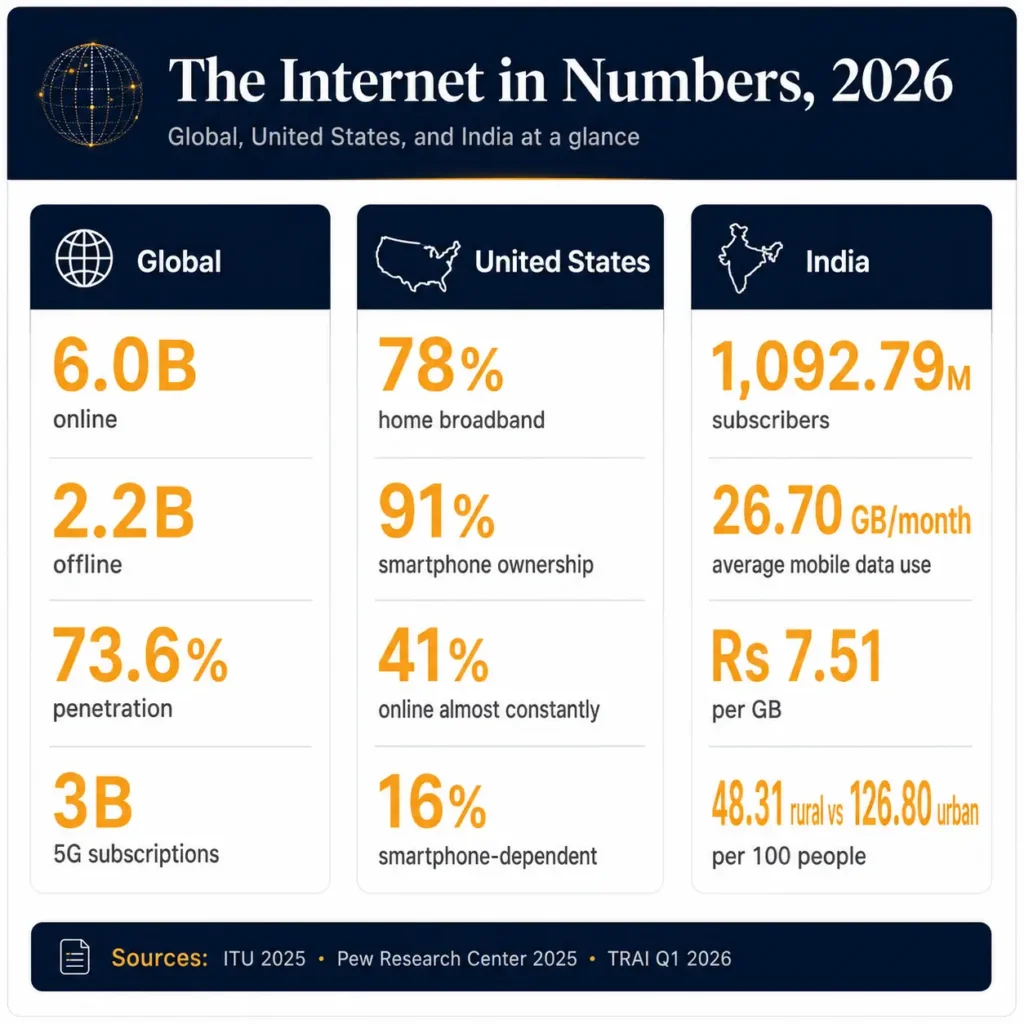
The Internet in Numbers, 2026
| Measure | Figure | Source |
|---|---|---|
| People online worldwide | ~6.0 billion (73.6%) | ITU, Facts and Figures 2025 |
| People still offline | 2.2 billion | ITU, Facts and Figures 2025 |
| Growth in online population, 2024–25 | +240 million | ITU, Facts and Figures 2025 |
| US adults using the internet daily | ~90% | Pew Research Center, 2025 |
| US adults online “almost constantly” | 41% | Pew Research Center, 2025 |
| US adults with home broadband | 78% | Pew Research Center, 2025 |
| India internet subscribers | 1,092.79 million | TRAI, Q1 2026 |
| India average mobile data use | 26.70 GB per month | TRAI, Q1 2026 |
| India average cost per GB | ₹7.51 | TRAI, Q1 2026 |
| UPI transactions, July 2026 | 23.66 billion (₹29.88 trillion) | NPCI |
| Internet shutdowns worldwide, 2025 | 313 across 52 countries | Access Now |
| Reported US fraud losses, 2025 | $15.9 billion | FTC |
What the Internet Actually Is
The internet is a network of networks — a set of physical connections and shared protocols that lets independent computer networks exchange data. The World Wide Web is one service running on top of it, alongside email, messaging, video calls, and app traffic.
The distinction matters more than it sounds. When people describe the importance of the Internet, they usually mean the services layered on it rather than the network itself.
Those services change constantly. The underlying network has stayed remarkably stable since the 1980s, which is exactly why so much could be built on top of it.
Why Is the Internet Important? The Short Answer
The internet is important because it removed distance as a cost. Anything that could be turned into data — a lesson, a diagnosis, a payment, a job application, a government form — stopped needing a building, a queue, or a journey.
That shift is now large enough to measure at the level of national economies. It is also uneven enough that measuring it exposes who was left behind.
How many people are online in 2026
About 6 billion people use the internet, roughly 73.6% of the world’s population, according to the ITU’s Measuring Digital Development: Facts and Figures 2025. That is up from 53.9% in 2019, and the online population grew by more than 240 million in a single year.
The remaining 2.2 billion are not distributed randomly. Around 96% of people who are offline live in low- and middle-income countries.
How dependent are we, really
In the United States, nine in ten adults use the internet every day, and 41% describe themselves as online almost constantly, per Pew Research Center’s 2025 survey. In India, the average wireless subscriber consumed 26.70 GB of mobile data per month in the first quarter of 2026, according to TRAI’s quarterly performance report.
Neither figure describes occasional use. They describe a default state.
The United States and India compared
| United States | India | |
|---|---|---|
| Internet users | ~95% of adults online | 1,092.79 million subscribers |
| Home fixed broadband | 78% of adults | 46.54 million wired subscribers |
| Primary access mode | Mixed fixed and mobile | Overwhelmingly mobile |
| Rural vs urban gap | 16% of adults rely on phone only | 48.31 vs 126.80 per 100 people |
| Average data cost | Among the highest globally | ₹7.51 per GB |
| Defining constraint | Affordability | Rural reach |
Sources: Pew Research Center 2025; TRAI Q1 2026.
The two markets have opposite problems. India solved cost and is still solving reach. The US solved reach and has not solved cost.
The Main Benefits of the Internet, by Domain
The benefits of the internet fall into seven areas, and they are easier to compare side by side than to read as a list. Most discussions of the importance of the Internet cover these same domains without ever separating them.
| Domain | What changed | Who gains most |
|---|---|---|
| Communication | Contact separated from distance | Families split across cities and countries |
| Education | Learning separated from location | Students outside major cities |
| Business | Market reach separated from premises | Small and home-based businesses |
| Healthcare | Consultation separated from travel | Rural and mobility-limited patients |
| Government | Services separated from offices | Anyone who used to queue |
| Money | Payment separated from cash | Informal and small merchants |
| Daily life | Information separated from schedules | Everyone, unevenly |
Each of these is covered in detail below. The pattern across all seven is the same: the internet did not invent new activities so much as remove the physical requirement from existing ones.
Why Is the Internet Important for Communication?
Why is the internet important for communication? Because it made the cost of reaching someone independent of how far away they are. A message to the next street and a message to another continent now cost the same, which was never true of post, telegram, or telephone.
Staying in touch across distance
Migration used to mean separation. A worker who moved from a village in Uttar Pradesh to a city, or from India to the Gulf, saw family in photographs and heard them on expensive, rationed calls.
Video calling ended that rationing. TRAI’s Q1 2026 data puts average voice usage at 1,017 minutes per subscriber per month in India — roughly 34 minutes of calling every day, on top of 26.70 GB of data.
Communication that does not need both people present
Messaging, email, and shared documents let people communicate without being available at the same moment. That sounds minor and is not: it is what makes cross-timezone work, distributed teams, and asynchronous study possible.
It also changed the shape of everyday contact. A group chat keeps a family or a class in continuous low-effort touch, which no scheduled call ever managed.
What communication gained, and what it cost
The gain is reach and immediacy. The cost is that availability became an expectation rather than a choice, and the pressure to respond quickly now follows people outside working hours.
Both things are true at once. Communication got cheaper, faster and more constant, and constant is not always better.
Why Is the Internet Important for Students and Education?
The importance of the internet in education comes down to one change: it broke the link between where a student lives and what they can learn.
The importance of the internet to students is easiest to see in places without good schools nearby. A student in a district town now opens the same lecture, dataset, and past paper as a student in Delhi or Boston.
Research and access to information
Students and teachers can reach primary sources — government data, published research, institutional archives — that were previously available only through a well-funded library. The constraint shifted from access to evaluation.
This is where the benefits of the internet are least disputed and easiest to observe. A student in a district town now opens the same dataset as a student in Delhi or Boston.
That shift creates its own problem. Finding a source is now trivial; judging whether it is reliable is the skill that matters, and it is taught far less often than searching.
Free and low-cost learning
Universities including Yale and Harvard publish course material through platforms such as Coursera and edX. Most courses can be audited without payment, though certificates and graded assignments usually carry a fee, and the free audit tier has narrowed over the years.
YouTube remains the largest informal learning platform in both markets. For competitive exam preparation in India in particular, it functions as parallel infrastructure to the coaching industry.
Real-time teaching and doubt-solving
Live online classes let students ask questions during a lesson rather than waiting for the next one. Recorded sessions let them revisit an explanation as many times as needed, which a physical classroom cannot offer.
Schools now run their own platforms for assignments and discussion. The practical gain is not the video — it is the persistence of the material after the class ends.
What online learning still cannot replace
Remote learning struggles with laboratory work, supervised assessment, and the informal peer contact that happens between classes. It also assumes a device, a connection, and a quiet place to sit, which is where the pros and cons of online school diverge sharply by household income.
Attendance data during and after the pandemic showed the gap clearly. Students without reliable connections did not learn less efficiently — many simply could not attend.
Why Is the Internet Important to Business?
Why is the internet important to business? Because it removed the relationship between market size and physical presence. A business operating from one room can now reach customers in another country.
Reaching customers you could never reach offline
Search, social platforms, and marketplaces let a business be discovered by people who were not looking for that business specifically. That is a genuine break from how commerce worked before, where discovery required proximity or advertising budget.
For most companies, the importance of the Internet shows up here first — in digital marketing reaching audiences that no shopfront ever could.
The same channels supply feedback. Reviews, comments, and search queries tell a business what customers actually want, at a speed and volume no survey used to provide.
Internal communication and remote work
Distributed teams coordinate through email, messaging, shared documents, and video, and the coordination cost of an extra office location has fallen close to zero. Remote and hybrid work exist because that cost fell, not the other way round.
Email remains the formal record. Real-time tools carry the day-to-day work. The same shift is why an individual can now start a blog and reach readers without a publisher.
Brand building and reputation
A business now has a public reputation whether it manages one or not. Search results, reviews, and social mentions form an impression before any conversation happens.
This cuts both ways. The same visibility that lets a small business build credibility quickly also means a single unresolved complaint stays findable for years.
E-commerce and digital payments
Online retail is now ordinary rather than novel in both markets. Amazon and eBay anchor the US; Amazon, Flipkart and Myntra anchor India, alongside the government-backed ONDC network.
India’s payment layer is the more striking story. UPI processed 23.66 billion transactions worth ₹29.88 trillion in July 2026 — a record month, averaging 763 million transactions per day, according to NPCI. Volume rose 22% year on year, with growth concentrated in tier-2, tier-3 and rural markets rather than metros.
That is internet infrastructure doing work that cash used to do, at national scale.
Why Is the Internet Important to Society?
Why is the internet important to society? Because it changed who can reach a public service, and how long it takes them to get it.
Global connectivity and globalization
People, businesses, and governments now coordinate across borders as a routine matter. Supply chains, remote employment, and cross-border payments all depend on the assumption that a connection exists.
UPI now operates across several countries including Singapore, the UAE, Bhutan, Nepal, Sri Lanka, and Mauritius. Payment rails crossing borders is globalization at a level people actually touch.
Public services and e-governance
Government services moved online in both markets, though along different paths. In India, DigiLocker holds verified documents, UMANG consolidates central and state services, and Aadhaar-linked authentication underpins subsidy transfer and verification.
In the US, tax filing, benefit claims, licence renewal, and federal job applications all run through .gov portals. The gain is the same in both cases: fewer trips, shorter queues, and a record the citizen can check.
The catch is that a service delivered only online is unavailable to anyone without access. E-governance makes the digital divide a matter of citizenship, not convenience.
Why the Internet Matters in Healthcare
The internet matters in healthcare because it moved consultation, monitoring, and record-keeping away from the hospital building. It has not moved treatment.
Health information, and how to use it safely
Hospitals, medical associations, and public health agencies publish reliable material online, and patients arrive better informed than a generation ago. That is a real gain.
It comes with a warning. Symptom-matching against web content is not diagnosis, and self-treating on the strength of a search is how minor conditions become serious ones. Use online health information to ask better questions of a clinician, not to replace one.
Telemedicine and remote consultation
Video consultation now handles a substantial share of routine care — follow-ups, chronic disease management, prescription renewal, dermatology, and mental health support. India’s public eSanjeevani platform delivers consultations at national scale, and private services operate alongside it.
The benefit is largest where travel is the barrier. For a patient several hours from a specialist, a remote consultation is not a convenience but the difference between care and none.
Telesurgery: what it actually requires
Telesurgery — remote robot-assisted surgery — is real, and it is not what a consumer connection can support. In February 2024, surgeons completed an intercontinental 5G-enabled procedure spanning more than 10,000 kilometres between Orlando and Dubai.
The requirements are strict. Japan’s 2022 Remote Surgery Guidelines specify end-to-end latency of 100 milliseconds or less, and published research shows that round-trip latency beyond roughly that threshold impairs hand–eye coordination, while jitter and packet loss degrade depth perception.
Working systems use closed networks, VPN redundancy, fail-safe mechanisms, and regulatory approval. A good broadband connection is nowhere near sufficient, and any description suggesting otherwise is wrong.
The Importance of the Internet in Our Daily Life
Most people encounter the importance of the internet in our daily life through ordinary things rather than institutional ones. The pattern is small savings, repeated constantly, until the old way stops being an option.
Entertainment
Streaming replaced scheduled broadcast for a large share of viewing in both markets. The change is not that entertainment moved online but that it stopped being scheduled — the audience decides the timing.
News and information
News now updates continuously rather than daily, and reaches phones directly. Speed came at the cost of verification, which is why the same network that distributes journalism distributes misinformation efficiently.
Everyday logistics
Banking, bill payment, travel booking, food delivery, and appointment scheduling all shifted online. Each saved a small amount of time. Together they removed an entire category of errand from ordinary life.
How AI Changed the Internet
Artificial intelligence is not a separate subject from the internet. It is the newest layer built on top of it, and it has changed both how people reach information and what the network physically costs to run.
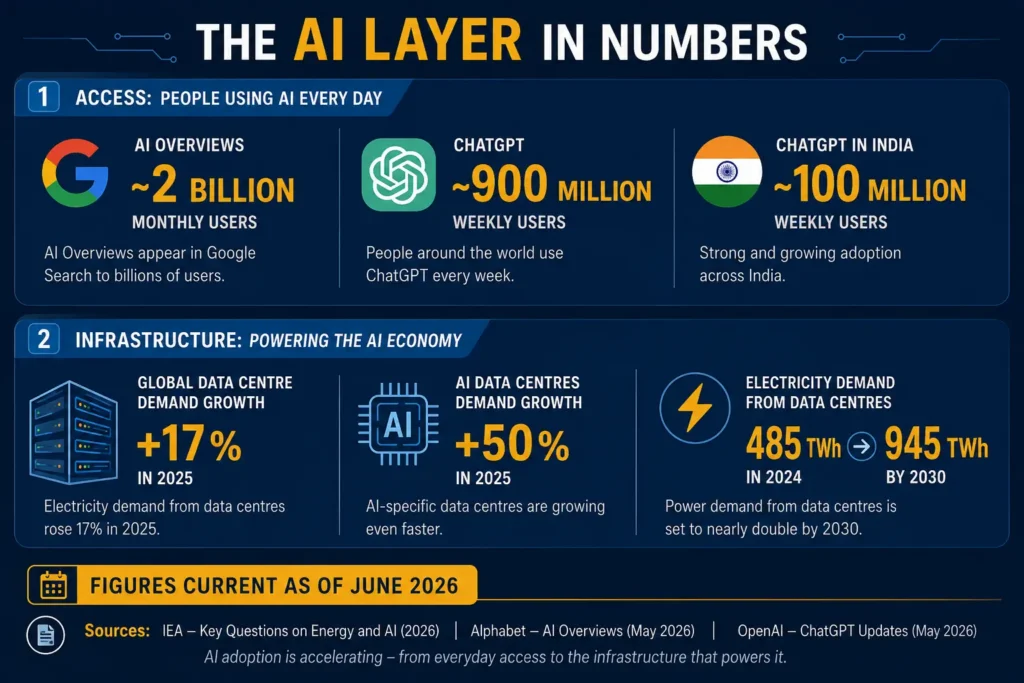
From links to answers
A large share of the world now receives answers rather than links. Google’s AI Overviews reach roughly 2 billion users per month, and ChatGPT reported around 900 million weekly active users as of February 2026, including approximately 100 million in India.
That is a structural change in what the internet does. For two decades the network’s job was to point you at a page; increasingly its job is to summarize the pages for you. Publishers, businesses, and anyone who depends on being found are still working out what that means — which is why ranking inside AI-generated answers has become its own discipline.
The internet you cannot see
Most people think of the internet as weightless. AI has made its physical footprint visible.
According to the IEA’s Key Questions on Energy and AI (April 2026), data centre electricity demand grew 17% in 2025, while AI-focused data centres grew 50% — against global electricity demand growth of 3%. Capital expenditure across the five largest technology companies passed $400 billion in 2025 and is set to rise a further 75% in 2026.
The IEA’s base case projects global data centre consumption roughly doubling from around 485 TWh in 2025 to about 945 TWh by 2030, just under 3% of global electricity. The same report notes that power consumption per AI task is falling rapidly, at a rate it describes as unprecedented in energy history.
Most web traffic is no longer human
Cloudflare’s June 2026 network data put automated traffic at 57.5% of HTML requests against 42.5% human. Much of that is AI systems reading pages to train on or to answer questions with.
The web was built on an exchange: crawlers took content and sent readers back. That exchange is being renegotiated, and the outcome will shape what gets published for free.
The AI layer in numbers
| Measure | Figure | Source |
|---|---|---|
| AI Overviews monthly reach | ~2 billion users | Alphabet |
| ChatGPT weekly active users | ~900 million | OpenAI, February 2026 |
| ChatGPT weekly users in India | ~100 million | OpenAI |
| Data centre electricity growth, 2025 | +17% | IEA |
| AI data centre electricity growth, 2025 | +50% | IEA |
| Projected data centre demand, 2030 | ~945 TWh (~3% of global) | IEA |
| Bot share of HTML web traffic | 57.5% | Cloudflare, June 2026 |
Figures current as of August 2026.
What Happens When the Internet Goes Away
The clearest evidence for the importance of the Internet is what happens when it is switched off.
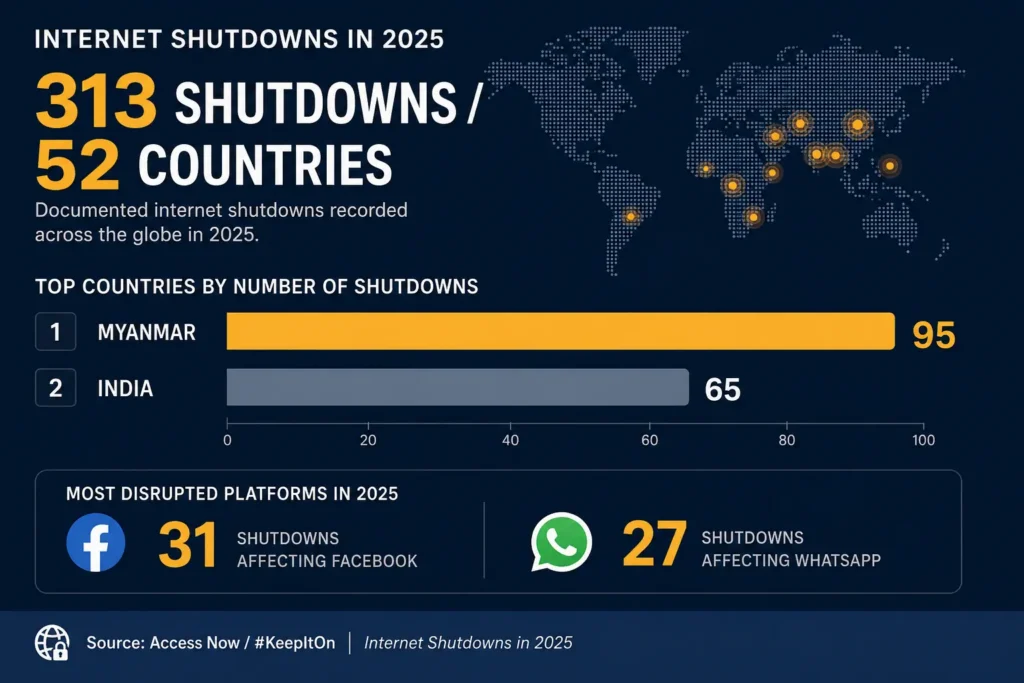
Internet shutdowns in 2025
Access Now and the #KeepItOn coalition recorded 313 internet shutdowns across 52 countries in 2025 — the highest number since tracking began in 2016. Myanmar led globally with 95, surpassing India for the second consecutive year.
India recorded 65, its lowest total since 2017 but still the highest of any democracy. Facebook was blocked 31 times across 18 countries; WhatsApp 27 times across 13.
What a shutdown costs
A shutdown does not only stop browsing. It stops digital payments, online exam registration, telemedicine consultations, ride-hailing, and the delivery of government benefits.
Nothing demonstrates the importance of the Internet more plainly than a district losing all of these at once.
In a market where UPI handles 763 million transactions a day, cutting connectivity in a district removes the payment system a daily-wage worker uses to get paid. Estimates put India’s economic loss from shutdowns in 2024 at roughly $323 million.
That figure is the importance of the internet expressed as a subtraction.
Who Is Still Offline
Around 2.2 billion people have no internet access, and the gap follows income, geography, gender, and age with unusual consistency.
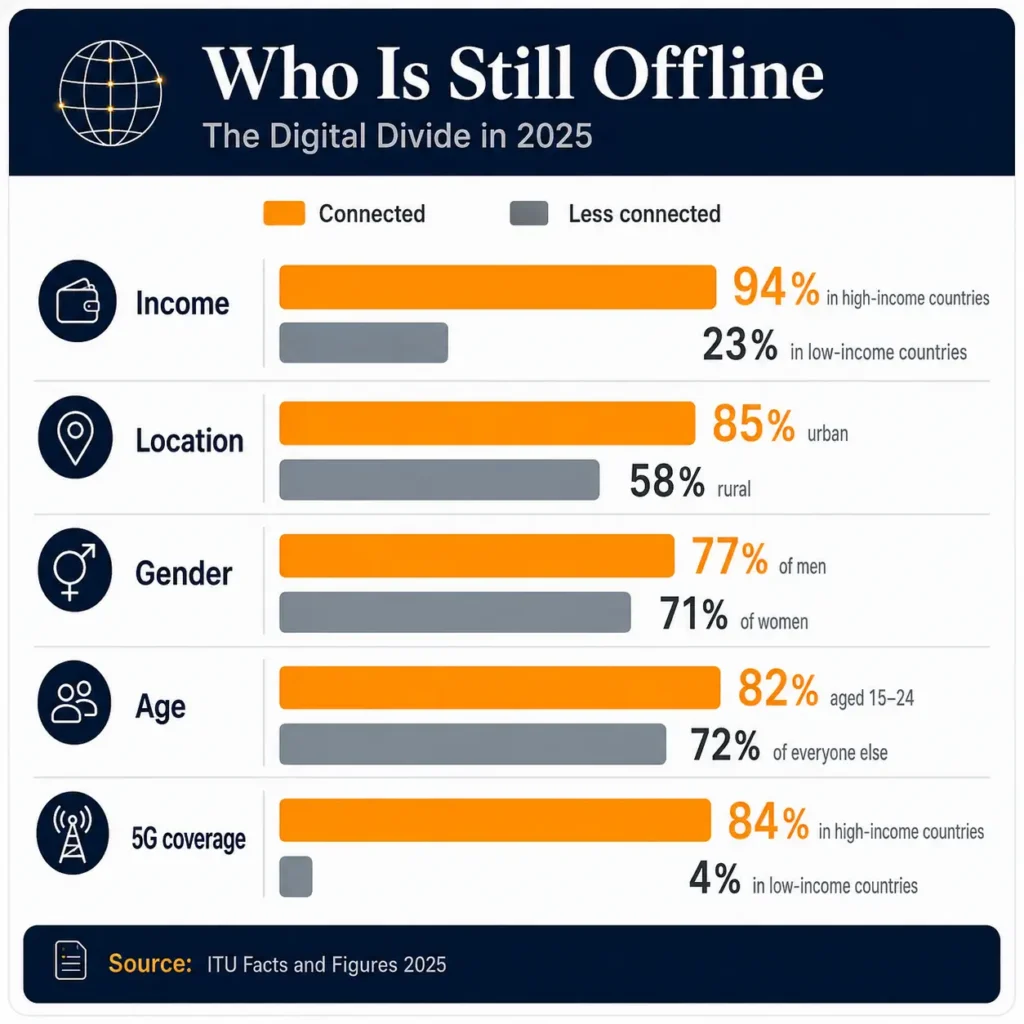
The global picture
| Divide | Connected | Less connected |
|---|---|---|
| Income | 94% in high-income countries | 23% in low-income countries |
| Location | 85% urban | 58% rural |
| Gender | 77% of men | 71% of women |
| Age | 82% aged 15–24 | 72% of everyone else |
| 5G coverage | 84% in high-income countries | 4% in low-income countries |
Source: ITU, Facts and Figures 2025.
A typical user in a high-income country generates nearly eight times the mobile data of a user in a low-income country. Being counted as online and being meaningfully online are different things.
The rural-urban gap in India
India has 1,092.79 million internet subscribers, but 651.93 million are urban against 440.87 million rural, per TRAI’s Q1 2026 report. Measured per head, that is 126.80 subscribers per 100 people in urban India against 48.31 in rural areas.
Fixed Wireless Access is closing the gap fastest, growing 15.81% in a single quarter to 17.11 million subscribers. It is the first technology to make home broadband viable where laying cable never was.
Smartphone dependence in the United States
Pew’s 2025 survey found 16% of US adults are smartphone dependent — they own a smartphone but have no home broadband subscription. That share has doubled since 2013.
It concentrates by income. About a third of adults in households earning under $30,000 are smartphone dependent, against 4% of those in households earning $100,000 or more.
The context matters: the Affordable Connectivity Program, which subsidised broadband for 23 million households, ended on 1 June 2024 when its $14.2 billion appropriation ran out. In March 2024 the FCC also raised its broadband benchmark from 25/3 Mbps to 100/20 Mbps, which reclassified a large number of connections as inadequate.
The Importance of Internet Safety and Security
The importance of Internet safety and security is measurable in the same way everything else here is: in money lost. Being connected carries a financial risk that is growing faster than connectivity itself.
Fraud by the numbers
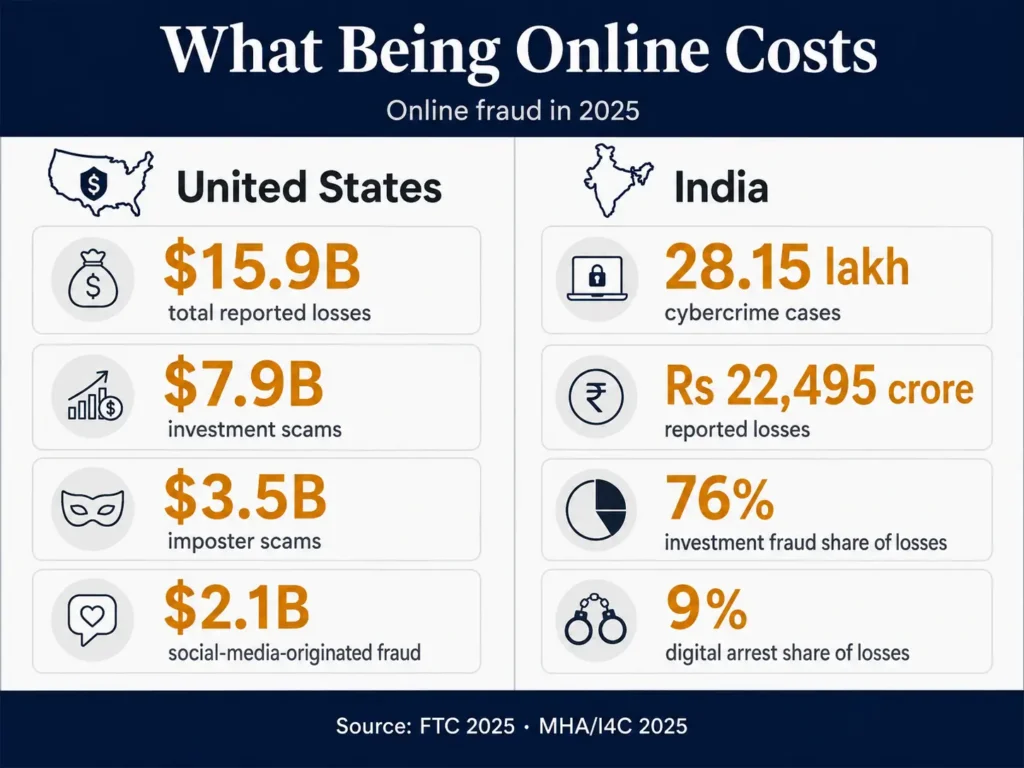
US consumers reported $15.9 billion in fraud losses in 2025, up from $12.5 billion in 2024, across 3 million reports, according to the Federal Trade Commission. Reported losses have risen roughly 430% since 2020.
In India, cybercrime cases rose 24% to 28.15 lakh in 2025, with reported losses of ₹22,495 crore, per Ministry of Home Affairs data presented to Parliament.
| Category | United States (2025) | India (2025) |
|---|---|---|
| Total reported losses | $15.9 billion | ₹22,495 crore |
| Largest loss category | Investment scams — $7.9 billion | Investment fraud — 76% of losses |
| Most reported category | Imposter scams — 1M+ reports | Sextortion — 19% of cases |
| Costliest contact method | Social media — $2.1 billion | Digital arrest — 9% of losses |
Sources: FTC 2025; MHA/I4C 2025.
What the scams look like now
Impersonation drives both markets. In the US, scammers pose as banks, government agencies, or relatives, often opening with a fake security alert and persuading the victim to move money to “protect” it.
In India, the digital arrest scam follows the same logic — fraudsters posing as CBI, ED, customs, or police officers pressure victims over video calls into transferring money for “verification.” Losses to this pattern accounted for 9% of India’s total.
Artificial intelligence has made both worse. The FBI attributed $893 million in losses to AI-assisted scams including voice cloning for distress calls and deepfakes in investment schemes, with older adults accounting for $352 million.
Eight steps that actually reduce your risk
- Turn on two-factor authentication for email and banking first — email is the recovery route for everything else.
- Use a password manager so every account has a unique password.
- Treat any unexpected message about money as fraudulent until verified through a number you looked up yourself.
- Never move money to “protect” it. No bank, tax authority, or police force will ask you to.
- Agree a spoken code word with family to defeat voice-cloning distress calls.
- Keep your operating system and browser updated — most malware exploits known, patched flaws.
- Check bank and card statements monthly rather than annually.
- Report immediately. Speed determines whether funds can be frozen.
Where to report it
In India, call the cybercrime helpline on 1930 or file at cybercrime.gov.in. Fast reporting matters: India’s I4C system has prevented fraud worth ₹8,031.56 crore, largely by freezing transfers before they clear.
In the US, report to the FTC at reportfraud.ftc.gov, and use IdentityTheft.gov if personal data was exposed.
Is the Internet Getting More Important, or Just Harder to Avoid?
Both, and the difference is worth naming. The importance of the Internet has grown for two unrelated reasons, and they call for different responses.
Some of the internet’s growing importance is genuine gain: a farmer checking prices, a patient consulting a specialist, a student learning without moving cities. Some of it is compulsion — services that withdrew their offline alternative, leaving no way to file a form, book an appointment, or receive a benefit without a connection.
The costs are real too. Constant connectivity is linked to attention fragmentation and sleep disruption, and the negative effects of smartphones are documented well enough to take seriously. The same network that distributes reliable information distributes falsehood at identical speed and lower cost.
None of this argues against the internet. It argues for treating it as infrastructure — something to be governed, made affordable, and made safe, rather than simply celebrated.
Key Takeaways
If you need to list the importance of the internet in our life briefly, these seven points cover it.
- About 6 billion people, roughly 74% of humanity, use the internet; 2.2 billion still do not.
- The importance of the Internet is measurable in what it replaced: distance, queues, and physical presence.
- India leads in scale and affordability — 1,092.79 million subscribers at ₹7.51 per GB — but rural penetration is 48.31 per 100 against 126.80 urban.
- The US leads in reach but not affordability, with 16% of adults dependent on a phone for all internet access.
- AI has added a new layer, changing how people find information and sharply raising the internet’s energy footprint.
- Shutdowns show importance by subtraction: 313 across 52 countries in 2025.
- Connection carries measurable risk — $15.9 billion in US losses and ₹22,495 crore in India during 2025.
Frequently Asked Questions
What is the importance of the internet?
The importance of the internet is that it removed distance as a cost. Education, healthcare consultation, payments, government services, and work no longer require physical presence, which is why roughly 6 billion people now depend on it. Its scale makes it infrastructure rather than a convenience.
Why is the internet important in our daily lives?
The importance of the Internet in daily life comes from the services it delivers that once required travel — banking, healthcare consultation, education, government paperwork, and shopping. In the US, 41% of adults describe themselves as online almost constantly; in India, the average subscriber uses 26.70 GB of mobile data monthly. Both figures describe dependence rather than convenience.
Why is the internet important today?
Why is the internet important nowadays, more than a decade ago? Because the offline alternative has been withdrawn. Tax filing, benefit claims, exam registration, wage payments, and medical records increasingly run online by default, so lacking access is now exclusion rather than inconvenience.
Why is the internet important for communication?
The internet is important for communication because distance stopped affecting cost. Indian subscribers average 1,017 voice minutes a month alongside 26.70 GB of data, per TRAI, and messaging lets people stay in contact without both being available at the same moment.
How many people use the internet in 2026?
Roughly 6 billion people, about 73.6% of the world’s population, according to the ITU’s Facts and Figures 2025. The online population grew by more than 240 million in a year, while 2.2 billion people remain offline.
What are the main benefits of the internet?
The benefits of the internet cluster into six areas: education without relocation, business reach without premises, healthcare without travel, government services without queues, payments without cash, and information without waiting. The common mechanism is the removal of a physical requirement from an existing activity.
Is the internet a necessity or a luxury?
In practice it is a necessity in both the US and India, because essential services have withdrawn their offline alternatives. When tax filing, benefit claims, exam registration, and wage payments run online by default, lacking access is exclusion rather than inconvenience.
What would happen if the internet stopped working?
Payments, logistics, healthcare scheduling, education, and government service delivery would halt simultaneously. Real shutdown data shows the shape of it: 313 shutdowns occurred across 52 countries in 2025, and India’s economic loss from shutdowns in 2024 was estimated at around $323 million.
How many people in India use the internet?
India had 1,092.79 million internet subscribers as of March 2026, per TRAI — 1,065.88 million on broadband and 26.91 million on narrowband. The split was 651.93 million urban and 440.87 million rural.
What are the disadvantages of the internet?
The main documented costs are fraud, misinformation, privacy loss, and attention and sleep disruption. Reported fraud losses reached $15.9 billion in the US and ₹22,495 crore in India during 2025, and both figures understate the true total because most victims never report.
Why is internet access important for rural areas?
Rural access determines whether people can reach services concentrated in cities — specialist healthcare, competitive exam preparation, market prices, and government benefits. India’s rural internet penetration of 48.31 per 100 people, against 126.80 in urban areas, is the clearest measure of that gap.
The Bottom Line
The importance of the Internet is no longer a matter of opinion, because it is now measurable. Six billion users, 26.70 GB a month in India, 23.66 billion UPI transactions in a single month, 313 shutdowns proving the cost of absence, and $15.9 billion in fraud proving the cost of presence.
The honest conclusion is not that the internet is good or bad. It is that the internet has become infrastructure — as consequential as electricity or roads, and deserving the same attention to who can afford it, who can reach it, and who is protected while using it.
That work is unfinished for 2.2 billion people.
