
Quick answer: Guest posting means writing an article for a website you don’t own, which that site then publishes under your name. Marketers use it to reach a new audience, earn a brand mention, and sometimes a link. Google allows it — as long as the article genuinely serves the host site’s readers.
Most guides on this topic are written by people selling you something. Tool vendors turn it into a product demo. Agencies turn it into a price list.
This one is written from the other side of the desk. We publish contributed articles here, so we see what lands in an editor’s inbox and why most of it gets deleted. That perspective changes the advice.
- What Is Guest Posting?
- What Is Guest Posting in SEO?
- Why Guest Posting Still Works
- Should You Guest Post? A Decision Framework
- How to Find Guest Posting Opportunities
- How to Vet a Site Before You Pitch
- What Editors Reject — Notes From Our Own Pitch Inbox
- Guest Posting in India vs the United States
- How to Measure Whether It Worked
- Common Guest Posting Mistakes
- Frequently Asked Questions
What Is Guest Posting?
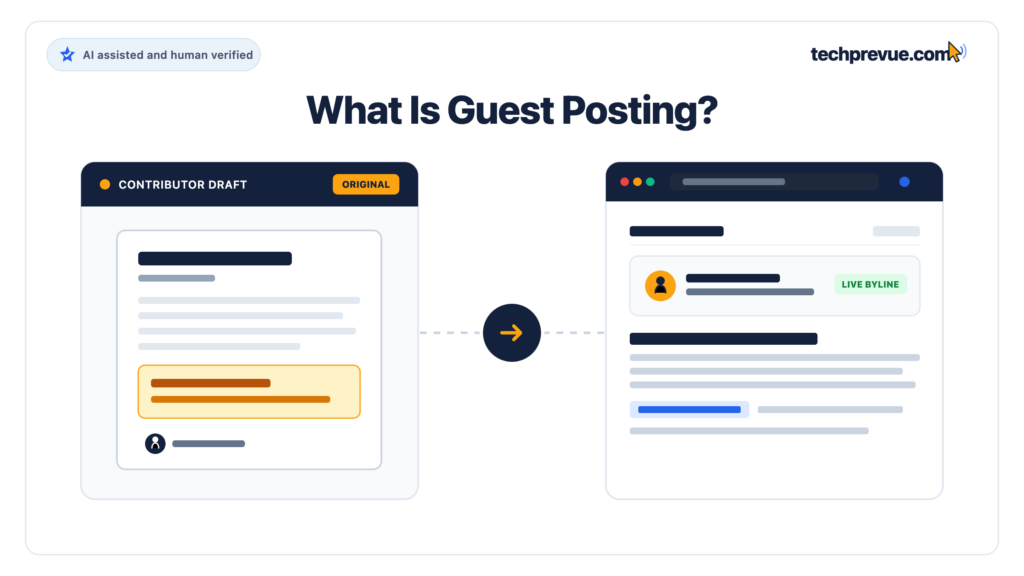
Guest posting means publishing your writing on a website someone else owns and operates.
You supply the article. They supply the audience.
How guest posting works, in three steps:
- Find sites in your field that publish outside contributors.
- Pitch an article idea to the editor or content lead.
- Write the piece to that site’s standards and submit it.
That’s the whole mechanism.
Everything else — vetting prospects, running outreach, negotiating over link attributes — is detail hanging off those three steps.
What Is a Guest Post?
A guest post is the article itself — the practice is guest posting, and the artifact is a guest post.
Your byline sits on it, usually alongside a short author bio at the top or bottom of the page. That bio is where most sites let you mention your company and, if their policy permits, link to it.
Some publications call these contributor posts, partner posts, or contributed articles. Google groups all of these together in its own guidance, so the label doesn’t change how the links are treated.
Guest Post vs Sponsored Post vs Niche Edit vs Syndication
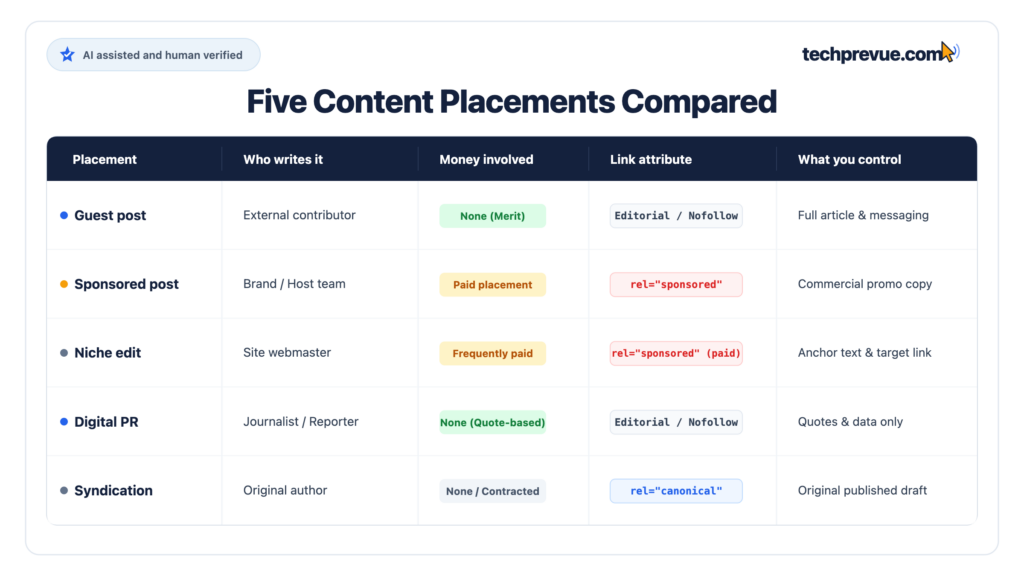
These four get used interchangeably, and they shouldn’t be. The differences decide what disclosure you owe and what link attribute the host has to apply.
| Placement | Who writes it | Money involved | Link attribute | What you control |
|---|---|---|---|---|
| Guest post | You | Usually no | Followed link acceptable if unpaid and editorial | The whole article |
| Sponsored post | You or the host | Yes, always | rel="sponsored" | The article, labeled as paid |
| Niche edit | Nobody — a link is added to an existing page | Usually yes | rel="sponsored" if paid | Only the link |
| Digital PR | A journalist, quoting you | No | Editorial or nofollow, their call | Only your quote |
| Syndication | You, originally for your own site | Sometimes | rel="canonical" to the original | An article you already published |
Two takeaways. If money changed hands, it is not a guest post anymore — it’s advertising, and it needs the sponsored attribute. And a niche edit is not guest posting at all, because you never wrote anything.
Digital PR trips people up most often. You supply a quote or a dataset and a journalist builds their own story around it, which means they control the framing, the headline, and whether you get a link at all. Guest posting hands you the entire article instead, and that difference in control is why the two need separate budgets and separate expectations.
One correction worth carrying, because most guides haven’t updated it: HARO shut down in December 2024, and Connectively closed with it. Featured relaunched the HARO brand in April 2025, and Qwoted covers similar ground.
What Is Guest Posting in SEO?
Guest posting for SEO is an outreach tactic used to earn links, mentions, and referral traffic from websites you have no control over. It sits inside the wider discipline of earning links from other websites.
The tactic has survived twelve years of Google guidance aimed squarely at it, which tells you something about how the search engine actually treats it.
Here’s the part most articles get wrong. Guest posting is neither automatically safe nor automatically penalized. Google’s position is conditional, and the condition is intent.
What Google Actually Says About Guest Post Links
Google has addressed this directly, twice, and both statements are still live.
In May 2017, Google published guidance on links in large-scale article campaigns. It said plainly that it does not discourage contributor or guest posts when they inform readers, educate another site’s audience, or raise awareness of a company or cause. The violation is when the main purpose is building links back to the author’s site at scale.
Google’s current spam policies name guest posts explicitly under link spam. The specific target is paid articles carrying links that pass ranking credit, and links with optimized anchor text placed in guest posts distributed across other sites.
That same policy also says something almost everyone skips over. Buying and selling links is a normal part of the web economy, and it isn’t a violation — provided those links carry rel="nofollow" or rel="sponsored".
So the rule is not “never pay.” The rule is: if you pay, the link can’t pass ranking credit.
Timeline worth knowing. In January 2014, Google’s Matt Cutts advised marketers to stop using guest blogging as a link tactic, describing the practice as increasingly spammy.
Three years later, the 2017 guidance replaced that blanket warning with the conditional test still in force today. Anyone telling you guest posting was banned in 2014 stopped reading too early.
When a Guest Post Crosses Into Link Spam
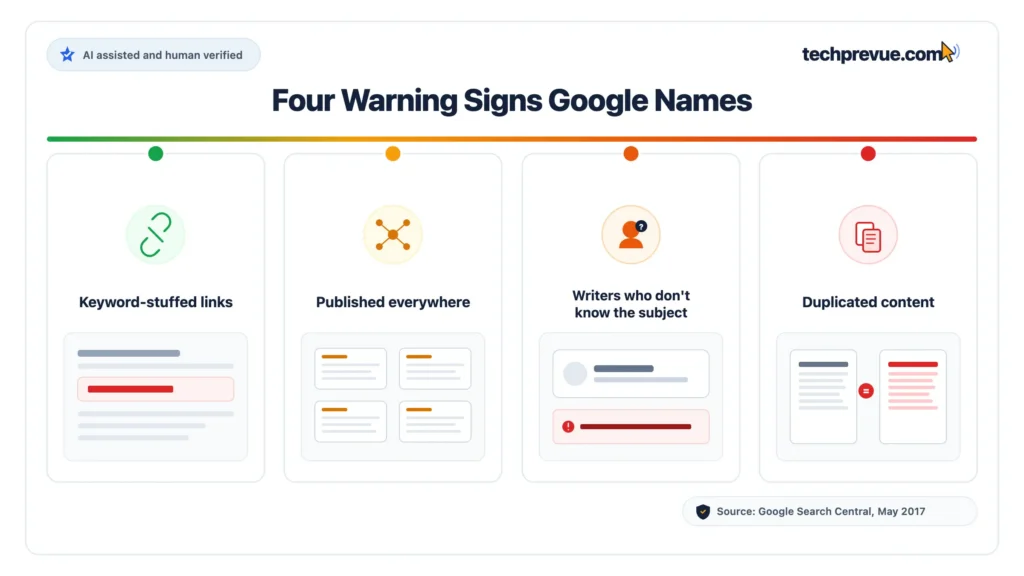
Google’s 2017 post lists four signals that, taken to an extreme, mark an article as a link scheme. They’re worth memorizing.
| Signal | What it looks like in practice |
|---|---|
| Keyword-stuffed links | Your article links to you three times using exact-match commercial anchors |
| Published everywhere | The same author byline appears on 40 unrelated sites in six months |
| Writers who don’t know the subject | A freelancer with no domain knowledge produced the piece for a flat fee |
| Duplicated content | The same or near-same article runs on multiple sites |
Notice what isn’t on that list. Nothing about paying, nothing about domain authority, nothing about how many guest posts is too many. Google’s test is whether a real reader comes away with something.
One anchor, branded or naked URL, in a piece you’re qualified to write, on a site your buyers actually read. That clears all four.
Site Reputation Abuse: The Rule for Sites That Publish Guest Posts
This one is newer, and it flips the risk onto the publisher.
Google’s spam policies now cover site reputation abuse — third-party content published on a host site mainly because of ranking strength the host earned with its own content. If a page is placed there to borrow the host’s authority, it’s a violation.
Google is careful to say that hosting third-party content is not itself a problem. Its own listed exceptions include editorial columns and opinion pieces, and advertorial content published to reach readers rather than to game rankings.
Contributors should care for one specific reason: it changes who’s exposed. If you place an article about payday loans on a university site, the university absorbs the damage, not you. Editors understand that now, and it explains a large part of why acceptance rates fell so sharply after the policy landed.
If you run a site that accepts contributions, the test is simple. Would this article make sense on your site if search engines didn’t exist?
Why Guest Posting Still Works
Plenty of people declared this tactic dead somewhere around 2014.
Far from it, but the reason to do it has shifted, and chasing links is now the weakest justification left on the list.
Reaching Readers Who Have Never Heard of You
Reach is the honest primary benefit.
A well-placed article puts you in front of people who would never have found your website through search, social, or anyone’s recommendation.
Publishers know this too, which is why the exchange survives. They get a piece of expert content they didn’t have to produce.
Brand Mentions and Visibility in AI Answers
Here’s what changed most since 2024.
Being named on trusted industry sites now feeds AI answer engines as well as Google’s index, and those two systems read the web differently.
Tools like ChatGPT, Perplexity, and Google’s AI Overviews pull from what they’ve read about you across the web. An unlinked mention on a respected industry site still counts toward that. Semrush now makes exactly this argument, and it’s the strongest case for guest posting in 2026.
That reframes the whole calculation. If the link is nofollowed, the placement is not wasted.
You can check whether any of this is landing without buying a tracking tool. Ask ChatGPT or Perplexity who the notable practitioners covering your subject are, and see whether your name or your company surfaces in the answer. Then query the same assistants for a framework or phrase you coined, and check whether the guest placement gets cited as the source.
Run both tests before your first placement so you have a baseline to compare against. Without one you’ll never know whether the needle moved.
Referral Traffic and Qualified Leads
A guest post on the right site sends visitors who already trust the publisher. That trust transfers, partially, to you.
Expect modest numbers arriving on a slow timeline, and judge them against that expectation rather than against a paid campaign. One marketer’s placement on Buffer’s blog reportedly brought a steady trickle of traffic and close to 400 email subscribers over 11 months. That’s a good outcome, not a typical one.
What Guest Posting Will Not Do for You
Straight talk, because most guides skip this.
- It won’t fix a weak site. Links to thin content don’t make it rank.
- It won’t produce fast results. Budget three to six months before you can read the effect.
- It won’t scale cleanly. The moment you industrialize it, you trip Google’s four signals.
- It won’t replace your own publishing. Guest posts support a content program; they don’t substitute for one.
Should You Guest Post? A Decision Framework
Before you write a single pitch, price the effort honestly. Semrush estimates 10 to 15 hours per guest post once you count research, pitching, drafting, and revisions. That matches our experience.
At that rate, four placements a quarter is a real line item. Two questions decide it: is your site ready, and are you.
Is your site ready?
| Where you are | Verdict | What to do instead, or next |
|---|---|---|
| New site, under 20 published articles | Wait | Build 20 to 30 solid articles of your own first. Editors check whether you can write before they check anything else. |
| Established site with real content behind it | Good fit | Target mid-sized specialist blogs where contextual links and referral traffic are both realistic |
| Recognized brand chasing pipeline | Be selective | Target the few publications your buyers actually read, and accept a low placement count |
| Looking to buy links in bulk | Stop | Bulk packages are the pattern Google’s four signals were written to catch |
The first row catches more people than the others combined. Pitching before you have a body of work gives an editor nothing to evaluate, and a rejection at that stage costs you the relationship for months afterward.
Are you ready?
| Question | Yes | No |
|---|---|---|
| Do you have expertise or data others don’t? | Proceed | Stop — you’ll get rejected |
| Can you commit 10+ hours per placement? | Proceed | Consider digital PR instead |
| Is brand awareness a current priority? | Proceed | Spend the time on your own site |
| Will you follow up with editors on revisions? | Proceed | You’ll stall after the first yes |
| Can you plan topics a month ahead? | Proceed | Deadlines will break you |
Four or five yeses means guest posting fits. Two or fewer means your time is better spent elsewhere, and there’s no shame in that call.
How to Find Guest Posting Opportunities
Finding sites is the easy part.
Finding sites worth twelve hours of your working week is the actual job, and it’s where most programs fall apart.
Sort Targets Into Three Tiers Before You Pitch
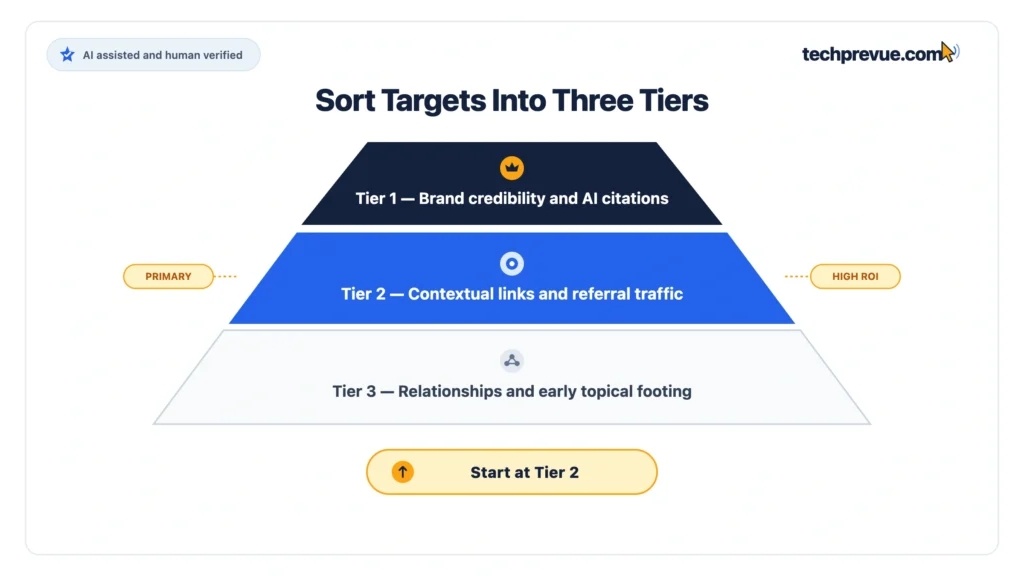
Treating every prospect the same is what makes outreach feel like a lottery. Sort the list into three tiers first, because each tier pays you back differently and deserves a different amount of effort.
| Tier | What it is | What you’re pitching for | Effort per piece |
|---|---|---|---|
| Tier 1 | The handful of publications everyone in your field reads | Brand credibility and AI citations | Your best work, no shortcuts |
| Tier 2 | Established specialist blogs with a clear topical focus | Contextual links and qualified referral traffic | Strong, but not career-defining |
| Tier 3 | Smaller practitioner sites, often one person | Relationships and early topical footing | Solid and useful, written efficiently |
Most guest posting programs fail by pitching Tier 1 exclusively and collecting silence for three months. Start in Tier 2, get published, then use those clips as proof when you approach the tier above.
Search Operators That Still Return Live Opportunities
Google search operators remain the fastest starting point. Skip the bloated 40-string lists floating around — most return the same results. Six of them do the job.
| Operator | What it surfaces |
|---|---|
[your topic] "write for us" | Sites openly accepting contributors |
[your topic] "guest post guidelines" | Sites with published standards, usually higher quality |
[your topic] inurl:"contribute" | Contribution pages missed by title searches |
[your topic] "this is a guest post by" | Sites that accept posts without advertising it |
allintitle: [your topic] guest post | Tighter, less noisy results |
[your topic] "contributing writer" | Publications with standing contributor programs |
Operator four earns its place. Sites with no “write for us” page get pitched far less, so your odds improve.
Reverse-Engineering a Competitor’s Backlinks
Run a competitor’s domain through any backlink tool and filter for pages with author in the URL. Author pages usually mean contributed content.
Not every guest post gets an author page, so also sort by strongest links and open a few manually. You’re looking for a byline that isn’t a staff writer’s.
Anything a competitor placed, you can pitch. That editor already accepts outside work in your subject area.
Tracing an Author Byline Across Sites
Pick someone in your field who contributes widely. Copy the headshot from their author bio and run a reverse image search on it.
Reverse image search returns every site that ran their byline. You get a ready-made target list, assembled at someone else’s expense.
Communities, Newsletters and Direct Editor Requests
Editors post callouts on LinkedIn constantly. Following the content leads at publications you want to appear in beats cold emailing them.
Industry Slack groups and niche newsletters work the same way. The pitch you send after seeing a request has a far better hit rate than one sent blind.
When a Site Has No “Write for Us” Page
Plenty of good publications quietly accept contributions without advertising it. Backlinko documents the opposite trend too — sites shutting public submissions entirely, and others openly charging for placement, both driven by the flood of low-quality AI-written pitches.
For a site with no stated policy, find the person who owns the blog and ask one question: do they ever run outside contributors? Short email, no attachment, no pitch yet.
A no costs you two minutes. A yes puts you in a queue almost nobody else is standing in.
What to Pitch: Find Their Gap, Not Your Topic
Here’s where most pitches die.
Writers propose the subject they feel like covering rather than the subject a publication is visibly missing.
Pull up the target site and list the subjects they cover well. Then find the adjacent subject their competitors rank for and they don’t. That gap is your pitch.
Frame it as a gap in their coverage, not a favor to you. Editors respond to “your readers ask about X and you haven’t covered it” far more than to “I’d love to contribute.”
One variant almost nobody uses. Offer to rewrite an underperforming article they already have. Editors rarely have capacity for maintenance, and a credible offer to improve a page that’s slipping is much harder to refuse than a pitch for something new.
How to Vet a Site Before You Pitch
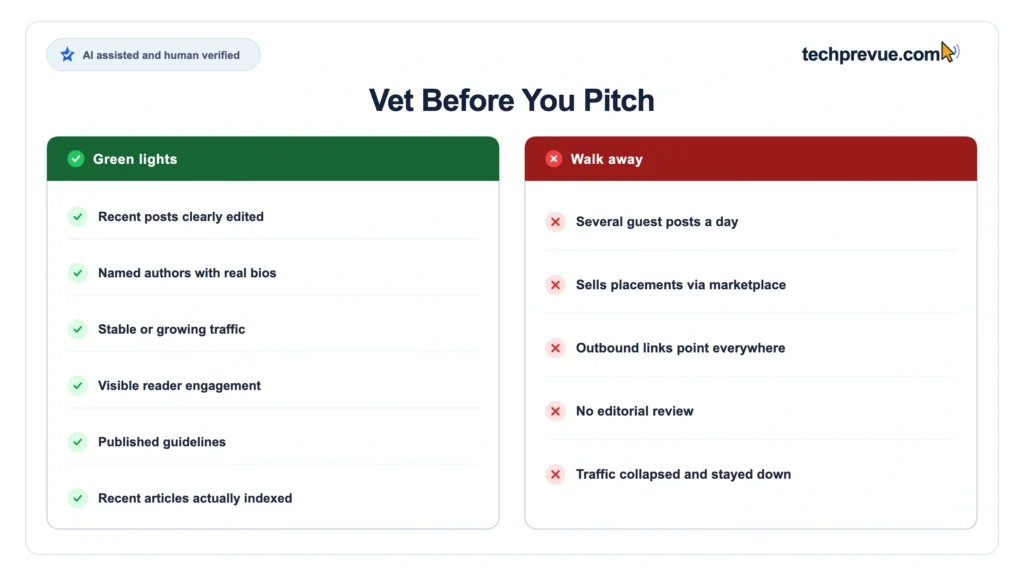
Give each prospect about 10 minutes. Semrush suggests roughly that, and it’s the right order of magnitude — enough to catch the obvious problems, not enough to waste a morning.
Green lights:
- Recent posts are well written and clearly edited
- Named authors with real bios and traceable credentials
- Organic search traffic that’s stable or growing
- Comments, shares, or visible reader engagement
- Published contributor guidelines
- Outbound links that go to sources, not to paying customers
- Recent articles that actually appear in Google when you search a distinctive phrase from them
That last check catches sites the traffic graph misses. Copy an unusual sentence from their newest post, search it in quotes, and see whether Google returns the page — if several recent articles never made it into the index, your piece won’t either, whatever the domain metrics promise.
Authority scores: use them, don’t trust them alone. Semrush suggests an Authority Score above 30 as a reasonable floor. Indian guest post marketplaces routinely push DA 30+ or DA 40+ as their selling point.
Both numbers are manipulable, and Backlinko is blunt about it — a domain can show strong metrics with no real audience behind them. Check the traffic trend line before you check the score. A site whose traffic fell off a cliff in 2023 and never recovered is not worth 12 hours, whatever its DA says.
Red Flags That Mean Walk Away
- It publishes several guest posts a day. No editorial team reviews that volume.
- It sells placements through a marketplace. Legitimate publications don’t list themselves on link vendor inventories.
- Outbound links point everywhere. Casino, crypto, and essay-writing links on a marketing blog mean the site takes anything.
- No editorial review. If they’ll publish your draft untouched, they publish everyone’s draft untouched.
- Content reads machine-generated. You’d be adding your name to a content farm.
- Traffic collapsed and stayed down. Often a sign of a past algorithmic hit.
Links, Nofollow and Paid Placements: What to Expect
Set expectations before you invest the hours. Three outcomes are all normal in 2026:
- A followed link. Increasingly rare. Semrush notes that many publishers simply don’t permit backlinks anymore.
- A nofollowed link. Common, and fine. You still get the reader, the referral traffic, and the brand mention that AI systems read.
- No link, just a mention. Also fine, for the same reason.
If the site asks for payment, the calculation changes. Paid placement isn’t forbidden, but the link must carry rel="sponsored" or rel="nofollow" under Google’s spam policies. A publisher who takes your money and promises a followed link is either uninformed or knowingly selling you risk.
Ask the question directly before you write a word: what link attribute do you apply to contributor links? An editor running a clean operation will answer in one line.
Check the published page afterward as well, because the answer you were given and the code that ships aren’t always the same thing. View the page source, find your link, and confirm the rel value matches whatever you agreed to.
If a site promised sponsored attribution and shipped a followed link instead, you’re now carrying exposure you never agreed to take on, and the fix is a polite email rather than a disavow.
What Editors Reject — Notes From Our Own Pitch Inbox
We publish contributed articles on this site, which means we’re on the receiving end of the tactics above. Here’s what the inbox actually looks like. <!– PUBLISHER DATA — Vinay to supply. Do not publish this section with invented figures. Needed: (1) approximate pitches received per month, (2) approximate acceptance rate, (3) top three rejection reasons in your own words, (4) optional: date range measured. If you’d rather not publish numbers, delete this block and the section runs qualitatively. –>
[INSERT: pitch volume and acceptance rate, with the period measured]
The rejections cluster into a handful of patterns, and almost none of them are about writing quality.
The sender never read the site. A pitch arrives for a topic we covered eight months ago, or for a subject we’ve never touched. Thirty seconds of reading would have caught it.
The topic is a vehicle for the link. You can see it in the outline. The article exists to reach paragraph nine, where the commercial mention sits.
The writer has no standing to write it. No credentials, no first-hand experience, no data. Just a summary of what already ranks.
The draft is unedited AI output. It’s obvious, it’s common, and it’s an instant no.
The pitch is a mass email. No name, no reference to anything we published, a subject line sent to 200 sites that morning.
Fix those five and you’re ahead of most of the queue. None of them require you to be a better writer than the competition — only a more attentive one.
Why Publishers Accept Guest Posts at All
Worth understanding, because knowing the answer tells you exactly what to offer.
Editorial calendars have gaps in them.
A site publishing twice a week needs roughly 100 finished pieces a year, and very few in-house teams have that kind of capacity sitting spare. A contributor who covers a subject the staff writers can’t is filling a genuine hole in someone’s schedule.
That gap is your opening.
Pitch the thing an in-house team can’t easily produce on its own — your proprietary data, your client case study, your operational experience.
Writing the piece itself is a separate discipline, and we cover it in detail in our guide to drafting and pitching.
Guest Posting in India vs the United States
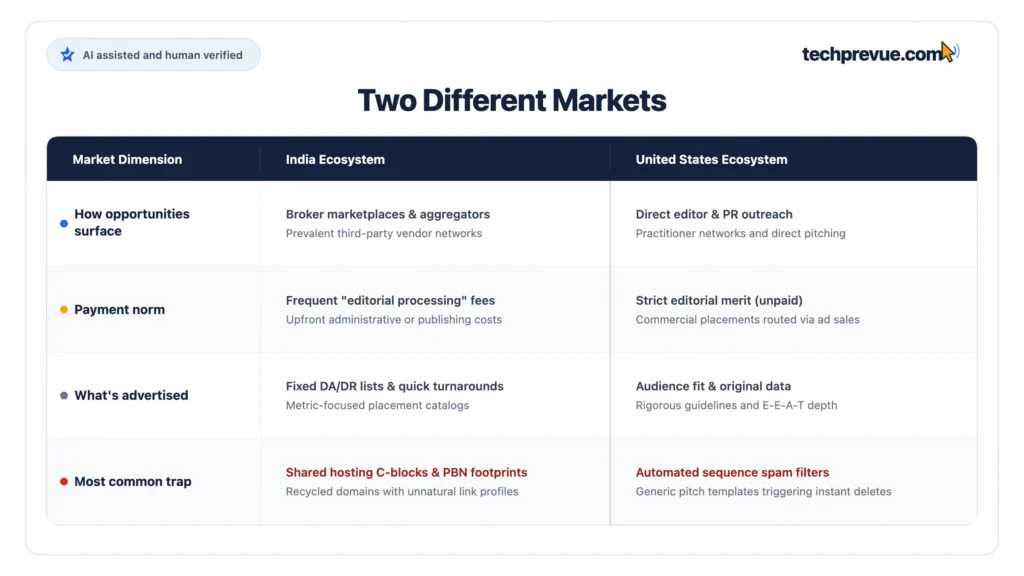
The same tactic behaves differently in the two markets, and advice written for one often misfires in the other.
| India | United States | |
|---|---|---|
| How opportunities surface | Marketplaces, agencies, curated site lists | Direct outreach, editor callouts, contributor programs |
| Payment norm | Paid placement is the default assumption | Paid placement is the exception and usually disclosed |
| What’s advertised | DA scores, Indian IP presence, turnaround time | Audience fit, editorial standards, reader numbers |
| Most common trap | Buying a followed link that should be sponsored | Sinking 15 hours into a site with inflated metrics |
Search for guest posting in India and the results are almost entirely commercial — agencies selling placements, verified site lists, and services promising vetted domains. Informational guidance barely appears.
That market shape creates a specific risk. When placement is something you buy rather than earn, the link attribute question gets skipped, and the buyer absorbs the exposure.
There’s a second mismatch that costs Indian marketers placements. Marketplace inventory is sorted by authority score rather than by subject, so a fintech brand ends up on a general lifestyle blog that happens to carry a DA 45 badge.
Google’s four warning signals catch that pattern quickly, because a contributor with no standing in the subject is one of the four.
If you’re working from India and targeting US publications, one adjustment matters more than any other. American editors weigh audience fit ahead of authority metrics, so open your pitch with who the article helps rather than with the domain score of the sites you’ve appeared on.
How to Measure Whether It Worked
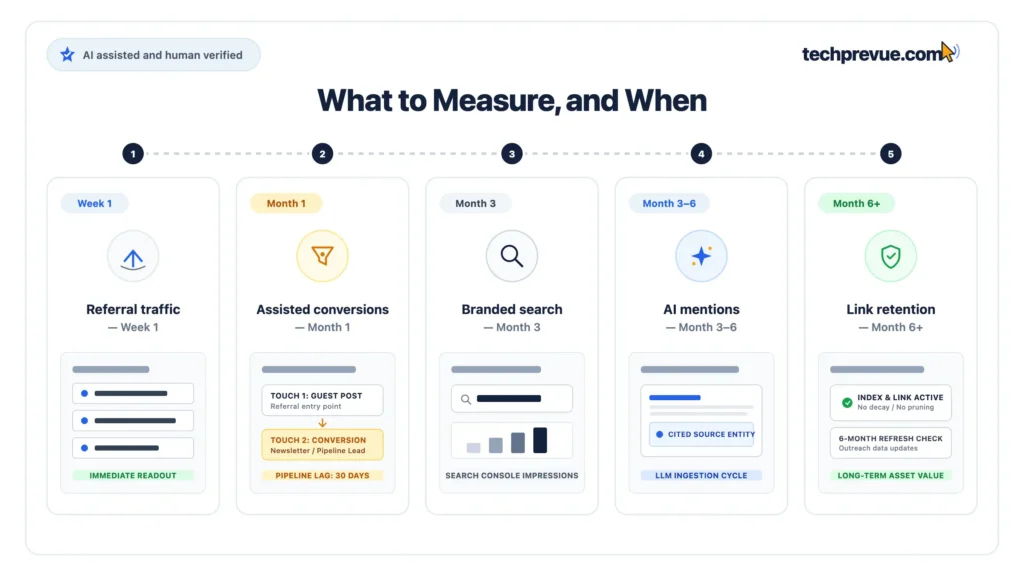
Most people measure this wrong by opening a rank tracker a week after publication.
Different signals surface on completely different timelines, and reading them too early produces a false negative.
| What to track | When it becomes readable | Where to find it |
|---|---|---|
| Referral traffic | Week 1 | Analytics, referral source report |
| Assisted conversions | Month 1 | Analytics, conversion path report |
| Branded search volume | Month 3 | Search Console, query filter on your brand |
| Brand mentions in AI answers | Month 3–6 | Prompt the major assistants about your category |
| Link retention | Month 6+ | Manual check — links get removed in redesigns |
Two rules govern the whole exercise.
Judge the guest posting program, not the individual placement. A single guest post rarely moves anything you can isolate in a report, so measure a quarter’s worth of placements together and compare that block against the quarter before it.
Then check again at month six. A meaningful share of placements quietly disappear during site redesigns, CMS migrations, and editorial cleanups, and nobody emails to tell you.
When a link does vanish, treat it as an opening rather than a loss. Email the editor offering updated figures or a fresh section for the article that used to carry it, and you often recover the link while giving them something genuinely useful. That approach works far better than asking why the link was removed.
Common Guest Posting Mistakes
- Using exact-match commercial anchor text instead of your brand or a plain URL
- Pitching before reading a single article on the target site
- Paying for a followed link, which puts the risk on you and the publisher
- Dropping the same article on multiple sites with light rewrites
- Treating the author bio as ad space instead of a credibility statement
- Pitching Tier 1 publications exclusively and collecting silence for a quarter
- Ghosting the editor when revisions come back
Frequently Asked Questions
Is guest posting still worth it in 2026?
Yes, for brand reach and AI visibility. It’s a weaker link tactic than it was a decade ago, because many publishers now nofollow contributor links by policy. Judge it on audience access first.
Is guest posting against Google’s guidelines?
Google’s guidance says contributed articles are fine when they inform or educate the host site’s readers. It becomes a violation when the main intent is building links at scale, or when a paid link passes ranking credit without a sponsored or nofollow attribute.
How many guest posts should I publish per month?
There’s no safe number, because volume isn’t the test — intent is. Two well-placed articles a quarter on relevant sites beat 20 placed anywhere.
Should I pay for guest posts?
You can, but the link has to be marked sponsored or nofollow. If a seller promises a followed link in exchange for money, they’re offering you a policy violation, whatever they call it.
What’s the difference between guest posting and guest blogging?
Nothing meaningful. Both describe writing an article for someone else’s site. Google uses “contributor posts” and “guest posts” interchangeably in its own guidance.
How do I find sites that accept guest posts?
Start with search operators, then reverse-engineer competitor backlinks and trace contributor bylines across sites. The strongest opportunities are often sites with no public submission page.
Do nofollow guest post links have any value?
Yes. They send referral traffic, put your name in front of a new audience, and contribute to the brand mentions that AI answer engines read when deciding who to cite.
