
Key takeaways
- A commission is not earned at the click. It gets recorded, validated, and only then approved. Expired attribution windows, competing referrals, and refunds all remove revenue that already appeared in your dashboard.
- You do not need a website. Video, newsletter, podcast, and social channels all work when the program’s terms allow them.
- The headline rate is the least useful number in the agreement. Geography, eligible traffic sources, attribution terms, reversal conditions, and payout thresholds decide what you keep.
- “Affiliate link” on its own is not an adequate disclosure in the US. The FTC’s position is that consumers may not understand it means you get paid.
- India adds a qualification rule most guides miss. Since March 2025, ASCI requires influencers giving financial or health advice to hold relevant credentials and state them upfront.
- Thirty days tests your workflow, not your profit. Judge approved actions and reversals, never pending totals.
- Some widely repeated tactics are simply dead. Amazon switched off affiliate banners in September 2023, and merchant-supplied copy now works against you rather than for you.
- What Is Affiliate Marketing?
- How Affiliate Marketing Works from Click to Payout
- Is Affiliate Marketing a Good Fit for You?
- How to Start Affiliate Marketing in Eight Steps
- Affiliate Disclosure in the US and India
- Metrics That Matter
- Affiliate Tactics That Stopped Working
- Common Failures and Scam Warnings
- Your First 30-Day Test
- Frequently Asked Questions
What Is Affiliate Marketing?
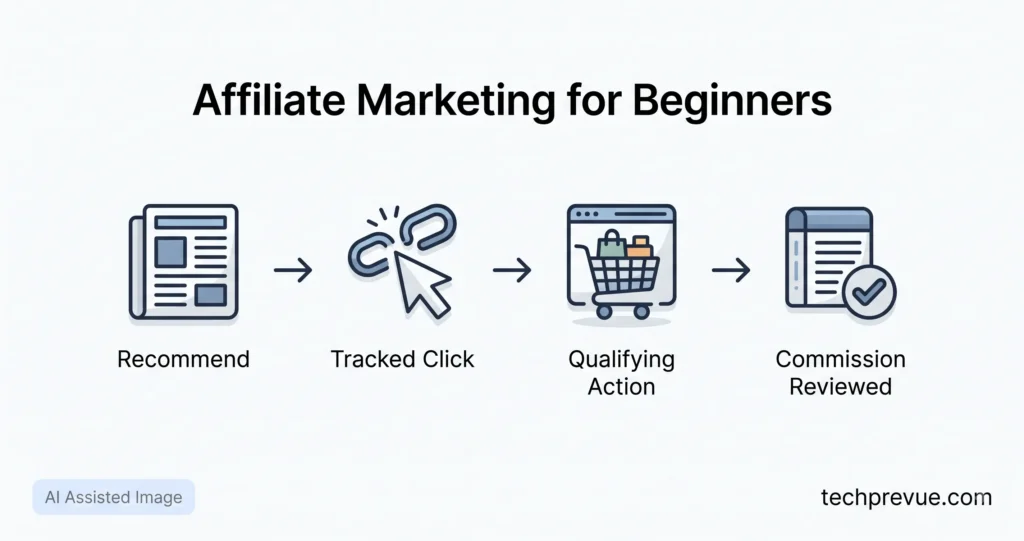
Affiliate marketing is a performance-based arrangement where you earn a commission for sending a merchant a customer, lead, signup, or other agreed result. You recommend something through useful content, share a tracked link, and get paid only when the program records and approves a qualifying action.
Those two words carry most of the weight. Recording and approval are separate events, often weeks apart, and plenty of recorded actions never reach approval. Anyone asking what is affiliate marketing usually gets the first half of that sentence and none of the second.
The link is the simple part. Building the audience trust that makes someone use it is not, and that is the gap most affiliate marketing for beginners content skips straight past.
How Affiliate Marketing Works from Click to Payout
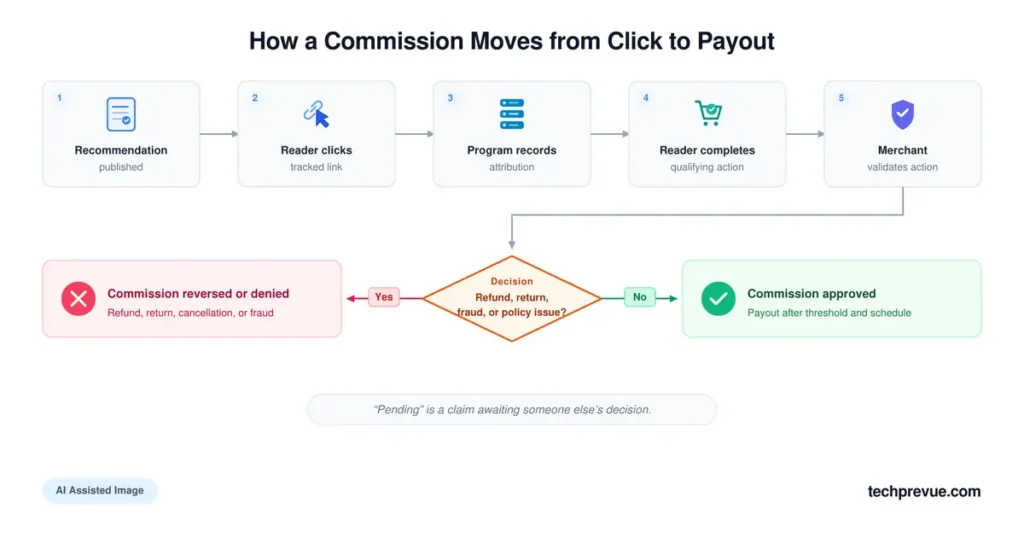
Affiliate marketing runs on a chain of events most beginners never see. So what actually happens after someone clicks?
The Four Roles
Most arrangements involve four parties. The merchant sells the product, the affiliate recommends it, the customer acts on that recommendation, and an optional affiliate network handles tracking, reporting, or payment between the others.
Picture a creator publishing a comparison of two budget microphones. A reader clicks the tracked link, buys within the program’s attribution period, and keeps the order. The program records the sale, the merchant approves it after the return window closes, and the creator is paid on schedule.
That path breaks more often than beginner guides admit. Another affiliate’s link may take credit, the attribution period may expire, a lead may fail the program’s quality rules, or the customer may cancel. Each of those removes revenue that already appeared in the dashboard.
A dashboard entry marked “pending” is not revenue. It is a claim awaiting a decision someone else makes.
The Main Payment Models
Programs define which result earns a commission. Read the agreement rather than the marketing page, because similar names hide different conditions.
| Model | Commission-triggering action | Common limitation |
|---|---|---|
| Pay per sale | A completed and approved purchase | Returns, cancellations, or excluded products may reverse it |
| Pay per lead | An approved form, application, or inquiry | Duplicate, incomplete, or unsuitable leads may be rejected |
| Pay per action | A defined event such as a signup or trial | The action may need to meet extra eligibility rules |
| Pay per install | A valid app or software installation | Device, country, or quality restrictions may apply |
| Recurring commission | A referred customer keeps paying for a subscription | Payment may stop after cancellation or a program time limit |
Some programs pay a percentage of the purchase; others pay a fixed amount. Our guide to choosing a blog niche covers how product category sets your earning ceiling before traffic enters the calculation. That ceiling is set by the merchant, not by how well you write.
The headline rate matters far less than the full arrangement: what qualifies, how credit is assigned, when an action is approved, and whether the merchant actually serves your audience well.
Is Affiliate Marketing a Good Fit for You?
Affiliate marketing for beginners works best when you already help an audience make decisions, or are willing to build that trust through consistent work. It complements a blog, video channel, newsletter, podcast, or an engaged social account.
Pros and Cons of Affiliate Marketing
| Pros | Cons |
|---|---|
| No product to build, stock, ship, or support | You control none of it — product, price, or quality |
| Low cash cost to start; time is the real investment | Income is unstable and slow to arrive, especially at first |
| Works alongside content you would publish anyway | Revenue can reverse weeks after it appears as earned |
| One good page can earn for years without edits | Every page needs maintenance as products and terms change |
| You choose which products deserve a recommendation | The merchant sets rates and can cut them without notice |
| Scales without adding hours once the content ranks | The program can suspend, change, or close your account |
| Recurring models keep paying while a customer stays | Attribution can hand your sale to another affiliate |
The honest summary: the upside is real but slow, and almost every important variable belongs to somebody else.
Two conditions should stop you outright. You cannot evaluate the product — direct use, a demonstration, reliable measurements, or documented research all count, but reading the sales page does not. You cannot maintain the content — links break, products get discontinued, and an abandoned recommendation misleads readers for years.
How to Start Affiliate Marketing in Eight Steps
1. Choose One Audience and Recurring Problem
Start with the person, not the commission. “Home recording” is broad. “Clearer video-call audio for remote workers in noisy rooms” names a reader, a constraint, and a repeatable set of decisions.
If you need a site-led direction, our framework for testing niche ideas separates real audience demand from a vague interest. Reject any topic you cannot cover with knowledge, access, or qualified review.
2. Choose a Primary Channel You Can Sustain
You do not need a website for every affiliate model. Choose the format that best demonstrates the answer and gives you reasonable access to the intended audience.
| Channel | Strong fit | Main tradeoff |
|---|---|---|
| Blog | Comparisons, detailed reviews, reference guides, search-led tutorials | Site maintenance, sourcing, updates, and discovery work |
| YouTube | Demonstrations, setup walkthroughs, products people need to see or hear | Recording and editing time; rights and platform policies apply |
| Social media | Short demonstrations, timely offers, an existing engaged audience | Link options change; older posts are hard to maintain |
| Newsletter | Recommendations for subscribers who already trust you | Needs permission-based growth and careful promotion frequency |
| Podcast | Products that benefit from explanation or spoken recommendation | Listeners cannot see the product or the link while hearing it |
A self-owned website gives you more control over presentation, updates, and measurement. If that matches your plan, our separate guide to starting a blog covers the setup, and the guide to creating a YouTube channel does the same for video.
3. Select Products You Can Evaluate Honestly
Choose products that solve a real audience problem and that you can discuss without pretending to experience you lack. A high rate cannot rescue an irrelevant recommendation. It only makes the mistake more expensive to your reputation.
Google’s review-quality guidance asks for demonstrated knowledge, evidence of actual experience, relevant measurements, explained differences, and honest coverage of both benefits and drawbacks. Those practices serve readers whether or not search is your main channel.
4. Compare Programs with a Scorecard
Check the official program agreement and help pages directly. Do not trust a “best programs” list. Availability and terms change by product, by channel, and by country.
| Question | Why it matters |
|---|---|
| Does the product fit the audience? | Relevance drives trust and the odds of a useful recommendation |
| Are my country and channel eligible? | Programs restrict locations, social accounts, email, paid ads, and other traffic sources |
| What action earns a commission? | A sale, lead, install, and trial each demand a different reader decision |
| How is attribution assigned? | Time windows, competing clicks, devices, and promo codes all affect credit |
| When can a commission be reversed? | Returns, cancellations, invalid leads, and policy breaches remove pending revenue |
| What are the threshold and schedule? | Approved earnings can sit unpaid until the account meets program conditions |
| How will I be paid? | Currency, transfer method, identity checks, and tax documents differ by country |
| Can the merchant support the customer? | Poor fulfillment or service damages your reputation, not theirs |
| What can end the relationship? | Programs change rates, remove products, suspend accounts, and close |
Save the terms you accepted and record the date you accepted them. Review material changes when they arrive instead of assuming the original agreement still applies.
5. Publish Useful Content Before Pushing Links
Build a small body of content that establishes whom you help and how you make decisions. Strong affiliate content helps the reader even when they decide to buy nothing. That is the test worth applying to every piece before it publishes.
Our guide to content marketing covers the wider strategy. For affiliate work specifically, four formats earn their place when they contain real evidence:
- A review explains who the product suits, who should skip it, and what happened during genuine use.
- A comparison identifies the conditions under which each option wins, instead of crowning a universal winner.
- A tutorial solves a problem and recommends a product only where it improves the process.
- A resource page organizes tools around a defined task and explains why each one belongs.
Manufacturer descriptions can support specifications, but they are not independent experience. State plainly what you tested, what you observed, what official documentation supports, and what remains unknown.
Plan Around Peak Retail Events
Seasonal content works in affiliate marketing for a reason most guides never mention: the terms themselves change during peak events. Commission rates get raised or cut for the period, categories move in and out of eligibility, and programs publish event-specific rules that override the standard agreement.
In the US that means Black Friday, Cyber Monday, and Prime Day. In India it means the Great Indian Festival, Big Billion Days, and the wider Diwali retail window, which run on a different calendar entirely.
Three practical consequences follow. Read the event terms before you publish, because a rate you quoted in October may not hold in November.
Promo codes and coupon stacking can break attribution, so check whether a code applied at checkout reassigns your commission. Publish early enough to get indexed, then update the page during the event rather than writing it the same week.
If organic search is your primary discovery channel, use the separate on-page SEO guide once the content has a clear reader and purpose.
6. Apply, Add Links, and Disclose the Relationship
Apply only once your channel accurately represents the work you plan to do. Programs review content quality, audience fit, identity, traffic methods, and previous policy compliance. A thin channel built purely to hold links tends to get rejected.
Place links where they help someone act on a recommendation. Do not bury them in unrelated text, load every paragraph with them, or style a commercial button to look like neutral navigation. Readers notice all three.
Placement is now a compliance decision as well as a conversion one. Because the disclosure has to be visible alongside the link, scattering links far from the recommendation forces you to repeat the disclosure or fail the standard. One clearly disclosed link inside the relevant passage beats six links chasing a click.
Disclosure is part of the recommendation, not a footer formality. The next section covers what that means in practice.
7. Track Clicks, Actions, Approvals, and Reversals
Start with the program dashboard and whatever analytics your publishing channel provides. Use sub-identifiers or campaign labels only where the program permits them. Avoid collecting personal data you do not need.
Pending commission exaggerates performance, sometimes dramatically. Base every decision on approved results. Record reversals too, so one generous return period or one weak lead source cannot masquerade as a winner.
8. Review the First 30 Days
Run the structured test described in your first 30-day test below, then make one decision: continue, change, or stop.
Affiliate Disclosure in the US and India
This section is general educational information, not legal advice. Requirements depend on your audience, location, industry, platform, and the exact commercial relationship, so verify the current rules that apply to you.
United States
The FTC’s endorsement guidance says any material connection that could affect how people weigh your recommendation must be disclosed clearly and conspicuously.
Three specifics are more useful than any generic advice:
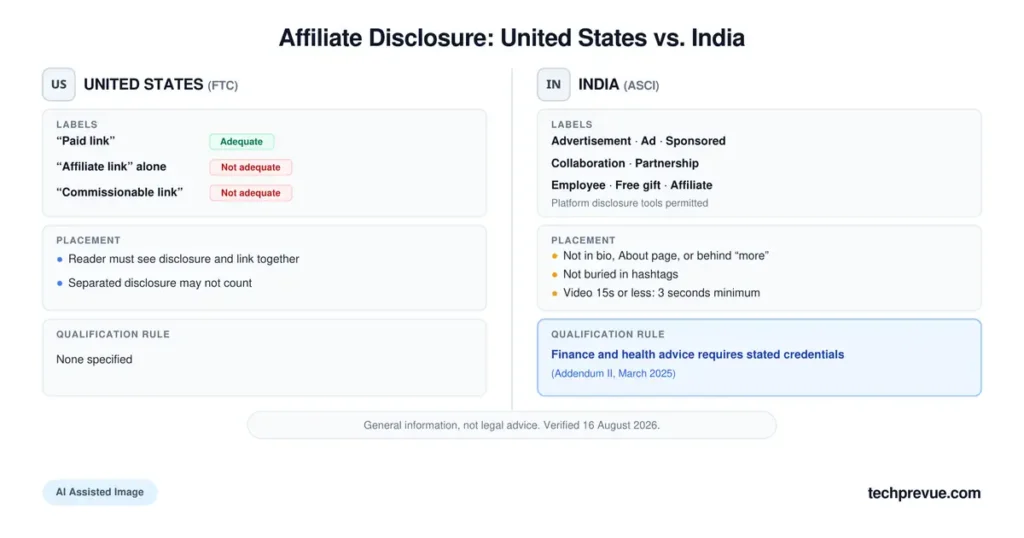
- “Affiliate link” by itself is not adequate. The FTC’s position is that consumers may not understand the phrase means you are paid for purchases through it. A “buy now” button fails for the same reason.
- “Paid link” placed right next to the link is adequate, when it is clear and conspicuous and the reader can see both the disclosure and the link at once.
- “Commissionable link” is not considered a clear disclosure.
The placement test is proximity. A single disclosure can be enough when the link sits inside the review and the reader sees both together — but if the disclosure and the link are separated, readers may never connect them. The FTC’s own suggested phrasing runs along the lines of stating that you get commissions for purchases made through links in the post.
Format changes the execution. A video endorsement generally needs the disclosure inside the video as well as near the links in the description, and the FTC’s guidance for social media creators covers channel-specific placement.
India
The ASCI guidelines for influencer advertising in digital media require an upfront, prominent disclosure wherever a material connection exists. ASCI defines material connection broadly — monetary compensation, free or discounted products including unsolicited ones, gifts, trips, media barters, awards, and family or employment relationships all qualify.
Its permitted disclosure labels are a fixed list: Advertisement, Ad, Sponsored, Collaboration, Partnership, Employee, Free gift, Affiliate, and any platform disclosure tool built for the purpose. The label must be in English or in the language of the advertisement itself.
Placement rules are specific. A disclosure appearing only in a bio, an About page, at the end of a post, or behind a “more” click is likely to be treated as missed. It must not be buried inside a block of hashtags or links either.
Video and audio carry timing requirements:
| Format | Disclosure requirement |
|---|---|
| Video, 15 seconds or less | Label stays visible for at least 3 seconds |
| Video, 15 seconds to 2 minutes | Label stays for one-third the length of the video |
| Video, 2 minutes or longer | Label stays for the entire section mentioning the brand |
| Live stream | Announced at the beginning and the end of the broadcast |
| Audio | Announced at the start and end, and before and after every break |
The rule most affiliate guides miss. ASCI’s Addendum II, dated March 6, 2025, adds a qualification requirement for two categories. Influencers giving advice on banking, financial services and insurance, or on health and nutrition products, must hold relevant credentials and state them upfront.
For stock or investment content that means SEBI registration, with the registration number shown alongside your name and qualifications. For other financial advice it means a qualification such as an IRDAI licence, CA, or CS. For health and nutrition it means a medical degree or a relevant certification as a nurse, nutritionist, dietician, physiotherapist, or psychologist.
If you do not hold those credentials, you can still share generic information that is not technical advice — but promoting an investment platform or a supplement through an affiliate link in India now sits squarely inside a rule that did not exist before 2025.
Program rules add another layer. The Amazon Associates Operating Agreement requires associates to identify themselves using a specified statement, which is one program’s requirement rather than a universal template.
Creators working on Instagram can review our detailed guide to shoutout disclosure and measurement for that platform’s campaign formats.
ASCI guidance verified against the ASCI Code Guidelines page on August 16, 2026. FTC guidance verified the same day.
Metrics That Matter
No single number proves an affiliate strategy is working. Read them as a sequence, because each one only makes sense in light of the one before it.
| Measure | Simple calculation | What it tells you | What it cannot prove |
|---|---|---|---|
| Qualified reach | Relevant views, visits, or subscribers | Whether suitable people find the content | That they trust or need the offer |
| Outbound click rate | Affiliate clicks ÷ relevant content views | Whether the recommendation earns interest | That the merchant converts or approves |
| Tracked conversion rate | Recorded actions ÷ tracked clicks | Whether the offer and merchant page work | That every action will be approved |
| Approval rate | Approved actions ÷ recorded actions | Whether tracked results survive validation | Why rejected actions failed |
| Reversal rate | Reversed actions ÷ recorded actions | Whether returns or quality issues erode results | Whether content or merchant caused it |
| Earnings per click | Approved commission ÷ tracked clicks | A comparable outcome across content and offers | Future income or production cost |
| Content cost | Time and direct expense per useful piece | Whether the workflow is sustainable | The value of trust or future reuse |
Read the sequence to locate the problem rather than to grade yourself.
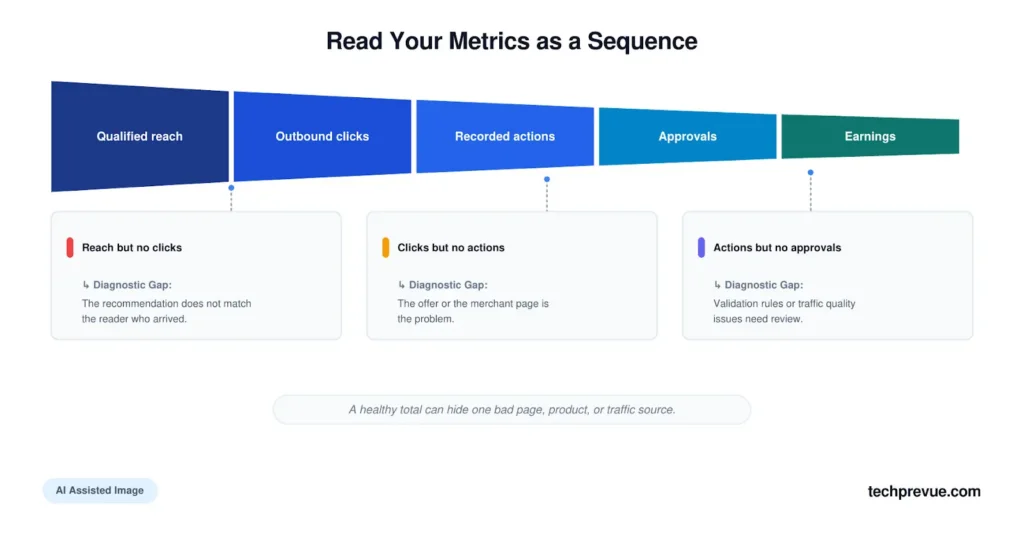
Reach without clicks usually means the recommendation is not relevant to the reader who arrived. Clicks without recorded actions points at the merchant’s page or the offer. Recorded actions without approvals points at the program’s validation rules or your traffic quality.
Track at the content and offer level wherever the program allows it. A healthy overall total conceals a great deal. One misleading article, one high-return product, or one traffic source quietly breaking the program’s terms can all hide inside a good-looking number.
Affiliate Tactics That Stopped Working
Plenty of affiliate marketing advice still circulating was written for a web that no longer exists. If you learned any of the following from an older guide, unlearn it.
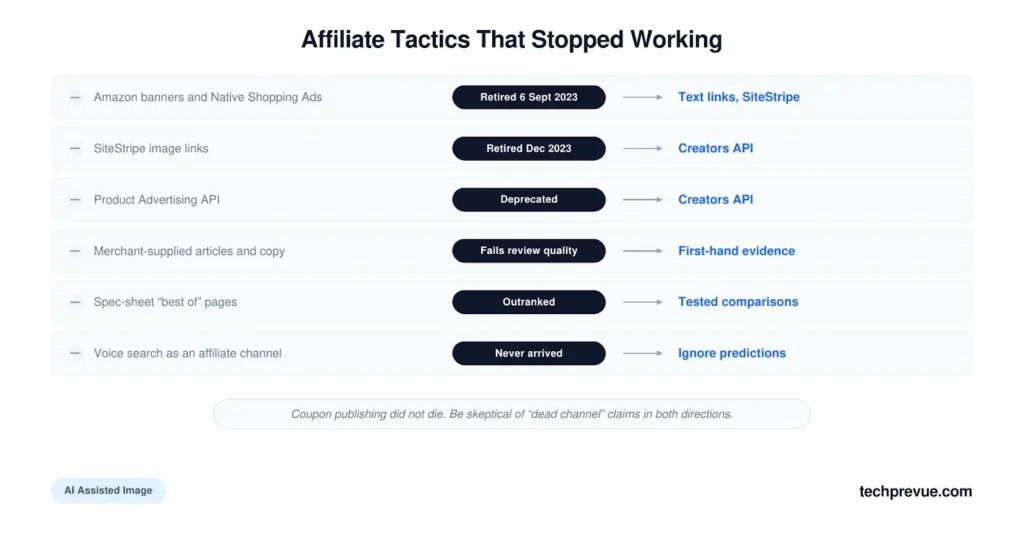
Banner ads and ad-style widgets. Amazon retired Mobile Popover, Banners, and Native Shopping Ads on September 6, 2023, and the units simply stopped rendering. Anyone still following advice to “add a few banners” is building around a format Amazon switched off years ago. SiteStripe image links went the same way in December 2023.
Programmatic product data on day one. Amazon’s Product Advertising API is deprecated in favor of the Creators API, which returns an access-denied error to applications still calling the old endpoint. Access now carries eligibility conditions, so a brand-new site cannot assume automated product feeds.
Publishing merchant-supplied copy. Older guides sold this as a benefit — the advertiser hands you articles, banners, and keywords, so you publish them. Google’s review guidance now asks for demonstrated first-hand evidence, and pages assembled from supplied promotional text are the definition of content that adds nothing.
Thin “best of” pages built from specifications. Rewriting spec sheets into a ranked list was a viable tactic for years. It competes now against the merchant’s own page, the manufacturer’s page, and an AI summary that reads all of them.
Betting on a predicted channel. Affiliate guides from around 2020 confidently named voice search as the next major channel. It did not become a meaningful affiliate surface, which is a useful reminder that a prediction in a marketing article is not a plan.
Assuming long cookie windows carry the sale. Third-party cookies are blocked by default in Safari and Firefox regardless of what a program advertises. Google confirmed in April 2025 that it will not remove them from Chrome, so browser behavior is split rather than settled. Treat a long advertised window as a ceiling, never an expectation.
One tactic that did not die, despite frequent predictions: coupon and discount publishing remains a large share of US affiliate revenue. Be skeptical of anyone declaring a channel dead, in either direction.
Common Failures and Scam Warnings
Promoting what you have not evaluated. A summary of merchant claims is not an independent recommendation. Narrow the claim, or get the access and expertise the claim requires.
Choosing the highest commission. A generous rate on a poor audience match produces weak content and unnecessary trust risk. Compare the whole program and the customer experience behind it.
Publishing thin decision pages. Rephrased specifications, generic “best” lists, and copied promotional text give readers nothing new. Useful pages make distinctions and show how the conclusion was reached.
Hiding the commercial relationship. A vague label or a remote disclosure denies readers the context they need to weigh your recommendation. It also fails the standard in both countries above.
Buying traffic before learning the economics. Paid promotion loses money fast, and many programs restrict bidding, brand terms, direct linking, or incentives. Test the audience-offer match and read the traffic rules first.
Ignoring reversals and link maintenance. A discontinued product, broken link, expired offer, or high refund rate makes old content inaccurate long after you have forgotten the page exists. Review the pages that earn your traffic and replace products that no longer serve readers.
Paying to unlock earnings. Avoid anything that demands unexpected fees to release commissions, guarantees fast returns, pressures you to recruit other buyers, or asks for account passwords. Use the program’s verified domain and official support channel.
Your First 30-Day Test
Thirty days is enough to test your affiliate marketing workflow. It is nowhere near enough to promise profit, and any guide suggesting otherwise is selling something.
Choose one audience problem, one primary channel, and one or two closely related products. Then publish three useful pieces: a problem-solving tutorial, a comparison, and a review or resource page built on evidence you can document. Nothing else.
Record production time, relevant reach, tracked clicks, recorded actions, approvals, reversals, and the questions your audience asks. Do not change every variable at once — a new channel, product, and message in the same week tells you nothing about which choice mattered.
At day 30, make one decision:
- Continue when the content helps the intended audience and produces qualified engagement or approved actions at a workload you can sustain.
- Change when people engage but the recommendation, format, or merchant experience creates a clear weak point.
- Stop when the product is a poor fit, the evidence cannot support the claim, the terms are unacceptable, or maintaining the content is unrealistic.
The test decides whether the system deserves another month. If the first month produced only more links, pick a better problem — or stop before trust becomes the cost.
